
Antigua and Barbuda
Antigua and Barbuda pairs Barbuda with the island of Antigua in the northeastern Caribbean.
- Capital
- Saint John's
- Region
- Caribbean
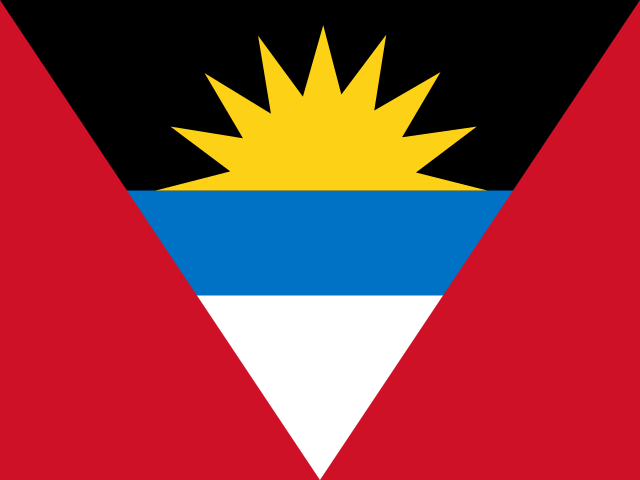
Flag of Antigua and Barbuda
The sun symbolizes the dawn of a new era, black represents the African heritage of most of the population, blue is for hope, and red is for the dynamism of the people.
Trace the big V between the red sides. Inside it, a yellow sun rises above a narrow strip of sea.
Languages and local life
Where the name comes from "antiguo" is Spanish for "ancient" or "old"; the island was discovered by Christopher COLUMBUS in 1493 and, according to tradition, named by him after the church of Santa Maria la Antigua (Old Saint Mary's) in Seville; "barbuda" is Spanish for "bearded" and the adjective may refer to the alleged beards of the indigenous people or to the island's bearded fig trees.
Language profile English (official), Antiguan Creole (an English-based creole).
Currency Eastern Caribbean dollar (XCD).
Borders and landscape
Area and borders Total area is about 442 km².
Landscape Mostly low-lying limestone and coral islands, with some higher volcanic areas.
From high to low Highest point: Mount Obama 402 m. Lowest point: Caribbean Sea 0 m.
Where it is
On the map Antigua and Barbuda pairs Barbuda with the island of Antigua in the northeastern Caribbean.
Where people live The island of Antigua is home to approximately 97% of the population; nearly the entire population of Barbuda lives in Codrington.
A person connected to this country
Profile Sir Isaac Vivian Alexander Richards (born 7 March 1952) is an Antiguan retired cricketer who represented the West Indies cricket team between 1974 and 1991. Usually batting at number three in a dominant West Indies team, Richards is widely regarded as one of the greatest batters of all time.
A Test debut Richards played his first Test match against India in 1974. Gordon Greenidge made his Test debut in the same match.