
Armenia
Armenia sits between Georgia and Iran in the South Caucasus, and Lake Sevan is its large inland lake.
- Capital
- Yerevan
- Region
- Western Asia
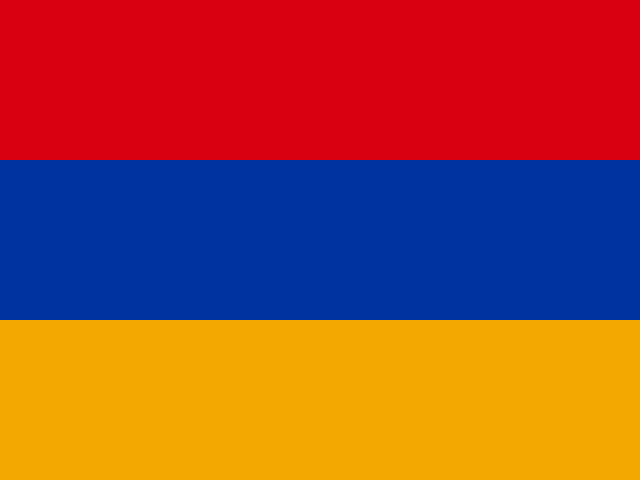
Flag of Armenia
The color red recalls the blood shed for liberty, blue the Armenian skies as well as hope, and orange the land and the courage of the workers who farm it.
Check the bottom stripe. Armenia ends in orange. Serbia also starts red over blue, but ends in white and adds a coat of arms.
Languages and local life
Where the name comes from The etymology of the country's name remains obscure; according to tradition, the country is named after Hayk, the legendary patriarch of the Armenians and the great-great-grandson of Noah; Hayk's descendant, Aram, purportedly is the source of the name Armenia.
Language profile Armenian (official) 97.9%, Kurmanji (spoken by Yezidi minority) 1%, other 1.1%; note - Russian is widely spoken (2011 est.).
Currency Armenian dram (AMD).
Food traditions
The tradition In Armenia, a team rolls lavash thin and stretches it over a cushion before pressing it against the wall of a clay oven. At weddings, the bread is placed on the couple’s shoulders for good fortune.
From oven to table The thin sheet can bake in well under a minute. It is also used as a wrap for cheese, greens or meat.
Borders and landscape
Area and borders Total area is about 29,743 km². It shares land borders with Azerbaijan, Georgia, Iran and Türkiye.
Landscape Armenian Highland with mountains; little forest land; fast flowing rivers; good soil in Aras River valley.
From high to low Highest point: Aragats Lerrnagagat' 4,090 m. Lowest point: Debed River 400 m.
Where it is
On the map Armenia sits between Georgia and Iran in the South Caucasus, and Lake Sevan is its large inland lake.
Where people live Most of the population is located in the northern half of the country; the capital of Yerevan is home to more than five times as many people as Gyumri, the second largest city in the country.
A person connected to this country
From ballet to concert hall Aram Khachaturian’s “Sabre Dance” comes from Gayaneh, a ballet he reworked during the Second World War from his earlier ballet Happiness.
Preserving the music The Aram Khachaturian Museum in Yerevan documents his ballet and film scores, including his music for the Armenian film Pepo.