
Belarus
Belarus lies between Poland and Russia, with the wet lowlands of the Pripyat basin at its southern edge.
- Capital
- Minsk
- Region
- Eastern Europe
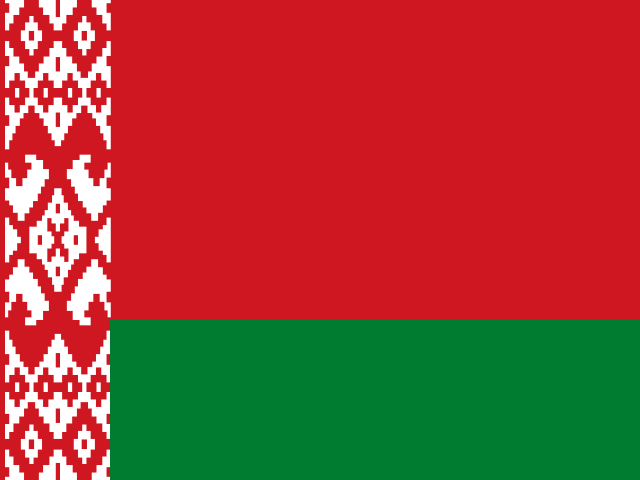
Flag of Belarus
The red band color recalls past struggles from oppression, the green band represents hope and the many forests of the country.
Start at the left edge. The red-and-white woven pattern separates Belarus from plain red-over-green flags.
Languages and local life
Where the name comes from The name is a compound of the Belarusian words "bel" (white) and "Rus" (the Old East Slavic ethnic designation) to form the meaning White Rusian or White Ruthenian.
Language profile Russian (official) 71.4%, Belarusian (official) 26%, other 0.3% (includes small Polish- and Ukrainian-speaking minorities), unspecified 2.3% (2019 est.).
Currency Belarusian ruble (BYN).
Borders and landscape
Area and borders Total area is about 207,600 km². It shares land borders with Latvia, Lithuania, Poland, Russia and Ukraine.
Landscape Generally flat with much marshland.
From high to low Highest point: Dzyarzhynskaya Hara 346 m. Lowest point: Nyoman River 90 m.
A person connected to this country
What they contributed “for developing semiconductor heterostructures used in high-speed- and opto-electronics”
The person Zhores Alferov, born in Vitebsk, Belorussia, received the 2000 Nobel Prize in Physics.
Where they worked A.F. Ioffe Physico-Technical Institute at the time of the award.
Where it is
On the map Belarus lies between Poland and Russia, with the wet lowlands of the Pripyat basin at its southern edge.
Where people live A fairly even distribution throughout most of the country, with urban areas attracting larger and denser populations.