
Burundi
Burundi is a small Great Lakes country south of Rwanda, with a shore on the northeastern end of Lake Tanganyika.
- Capital
- Gitega
- Region
- Eastern Africa
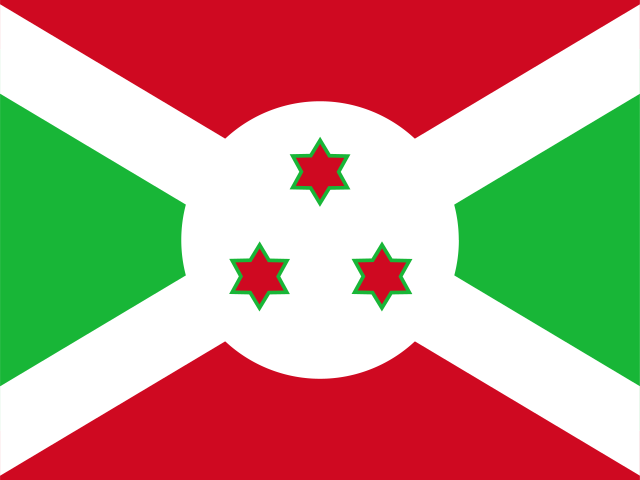
Flag of Burundi
Green symbolizes hope and optimism, white purity and peace, and red the blood shed in the struggle for independence.
Find three stars grouped in a circle. Their triangle sits where the white diagonal cross meets.
Languages and local life
Where the name comes from Name derived from the pre-colonial Kingdom of Burundi (17th-19th century).
Language profile Kirundi (official), French (official), English (official, least spoken), Swahili (2008 est.).
Currency Burundian franc (BIF).
Borders and landscape
Area and borders Total area is about 27,834 km². It shares land borders with DR Congo, Rwanda and Tanzania.
Landscape Hilly and mountainous, dropping to a plateau in east, some plains.
From high to low Highest point: unnamed elevation on Mukike Range 2,685 m. Lowest point: Lake Tanganyika 772 m.
Where it is
On the map Burundi is a small Great Lakes country south of Rwanda, with a shore on the northeastern end of Lake Tanganyika.
Where people live One of Africa's most densely populated countries; concentrations tend to be in the north and along the northern shore of Lake Tanganyika in the west; most people live on farms near areas of fertile volcanic soil.
A person connected to this country
Profile Pierre Nkurunziza (18 December 1964 – 8 June 2020) was a Burundian politician, educator, and rebel leader who served as the ninth president of Burundi from 2005 until his death in 2020. He was the longest-serving president in Burundian history, having served for nearly 15 years.
From classroom to parliament Nkurunziza taught physical education before becoming involved in the civil war. His movement became a political party after the war, and parliament elected him president in 2005.