
Central African Republic
The Central African Republic occupies the inland belt south of Chad, with the Ubangi separating much of it from the Democratic Republic of the Congo.
- Capital
- Bangui
- Region
- Middle Africa
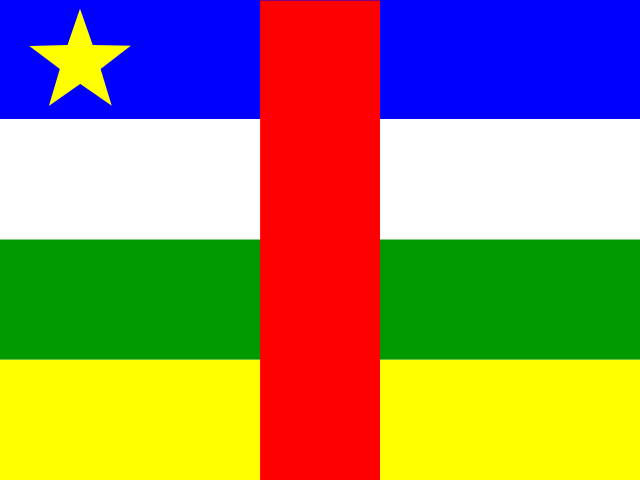
Flag of Central African Republic
Red symbolizes the blood spilled in the struggle for independence, blue represents the sky and freedom, white peace and dignity, green hope and faith, and yellow tolerance.
Look for a stripe going the other way. A red vertical band cuts across four horizontal ones in the middle.
Languages and local life
Where the name comes from Self-descriptive name specifying the country's location on the continent; "Africa" is derived from the Roman designation of the area corresponding to present-day Tunisia "Africa terra," which meant "Land of the Afri" (the tribe resident in that area), but which eventually came to mean the entire continent.
Language profile French (official), Sangho (lingua franca and national language), tribal languages.
Currency Central African CFA franc (XAF).
Borders and landscape
Area and borders Total area is about 622,984 km². It shares land borders with Cameroon, Chad, DR Congo, Republic of the Congo, South Sudan and Sudan.
Landscape Vast, flat to rolling plateau; scattered hills in northeast and southwest.
From high to low Highest point: Mont Ngaoui 1,410 m. Lowest point: Oubangui River 335 m.
Where it is
On the map The Central African Republic occupies the inland belt south of Chad, with the Ubangi separating much of it from the Democratic Republic of the Congo.
Where people live Majority of residents live in the western and central areas of the country, especially in and around the capital of Bangui.
A person connected to this country
Profile Jean-Bédel Bokassa ([ʒɑ̃ bedɛl bɔkasa] ; 22 February 1921 – 3 November 1996) was a Central African politician and military officer who served as the second president of the Central African Republic (CAR) and Emperor of the Central African Empire (CAE) as Bokassa I, ruling these two states from 1966 to 1979.
From the biography “Bokassa seized power in the Saint-Sylvestre coup d'état on 1 January 1966.”