
Chile
Chile's mainland forms a long strip between the Pacific and the Andes, but that outline leaves part of the country out. Rapa Nui lies thousands of kilometres to the west. Within the mainland, the dry Atacama in the north contrasts with fjords and islands in the south.
- Capital
- Santiago
- Region
- South America
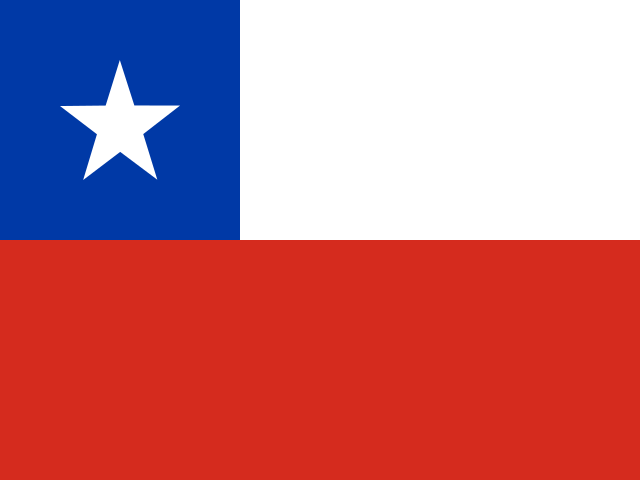
Flag of Chile
The white star symbolises a guide to progress and honour.
Chile fits its lone star into a blue square only as tall as the white band. Cuba puts its star in a red triangle.
Languages and local life
Where the name comes from Derivation of the name is unclear, but it may come from the Mapuche word "chilli" meaning "limit of the earth" or from the Quechua "chiri" meaning "cold".
Language profile Spanish 99.5% (official), English 10.2%, Indigenous 1% (includes Mapudungun, Aymara, Quechua, Rapa Nui), other 2.3%, unspecified 0.2% (2012 est.).
Currency Chilean peso (CLP).
Borders and landscape
Area and borders Total area is about 756,102 km². It shares land borders with Argentina, Bolivia and Peru.
Landscape Low coastal mountains, fertile central valley, rugged Andes in east.
From high to low Highest point: Nevado Ojos del Salado 6,893 m (highest volcano in the world). Lowest point: Pacific Ocean 0 m.
A person connected to this country
What they contributed “for a poetry that with the action of an elemental force brings alive a continent's destiny and dreams”
The person Pablo Neruda, born in Parral, received the 1971 Nobel Prize in Literature.
Where it is
On the map Chile's mainland forms a long strip between the Pacific and the Andes, but that outline leaves part of the country out. Rapa Nui lies thousands of kilometres to the west. Within the mainland, the dry Atacama in the north contrasts with fjords and islands in the south.
Where people live 90% of the population is located in the middle third of the country around the capital of Santiago; the far north (anchored by the Atacama Desert) and the extreme south are relatively underpopulated.