
Czechia
Czechia occupies the central European lands of Bohemia and Moravia, with Germany to the west and Slovakia to the east.
- Capital
- Prague
- Region
- Central Europe
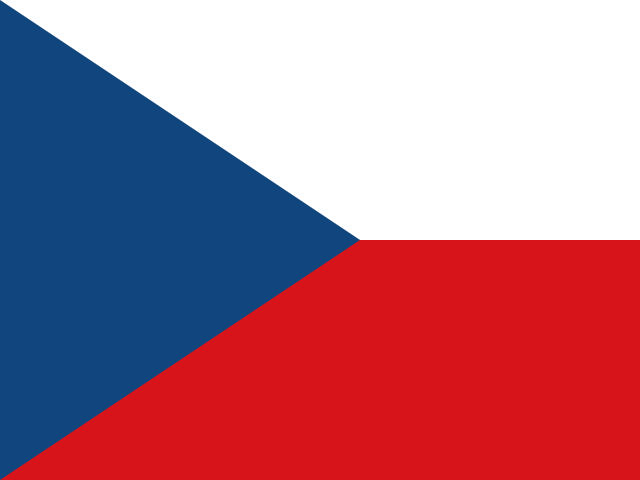
Flag of Czechia
The blue triangle was added to the original white and red design to distinguish it from Poland’s flag.
Take Poland’s white-over-red pattern and add a blue triangle at the left. That gives you Czechia.
Languages and local life
Where the name comes from Name derives from the Czechs, a West Slavic tribe who rose to prominence in the late 9th century A.D.; the country officially adopted the English short-form name of Czechia on 1 July 2016.
Language profile Czech (official) 88.4%, Slovak 1.5%, other 2.6%, unspecified 7.2% (2021 est.).
Currency Czech koruna (CZK).
Borders and landscape
Area and borders Total area is about 78,865 km². It shares land borders with Austria, Germany, Poland and Slovakia.
Landscape Bohemia in the west consists of rolling plains, hills, and plateaus surrounded by low mountains; Moravia in the east consists of very hilly country.
From high to low Highest point: Snezka 1,602 m. Lowest point: Labe (Elbe) River 115 m.
A person connected to this country
What they contributed “for the discovery of Giant Magnetoresistance”
The person Peter Grünberg, born in Plzen, received the 2007 Nobel Prize in Physics.
Where they worked Forschungszentrum Jülich at the time of the award.
Where it is
On the map Czechia occupies the central European lands of Bohemia and Moravia, with Germany to the west and Slovakia to the east.
Where people live A fairly even distribution throughout most of the country, but the northern and eastern regions tend to have larger urban concentrations.