
Dominica
Dominica sits between two French Caribbean islands and contains a geothermal lake in its mountainous interior.
- Capital
- Roseau
- Region
- Caribbean
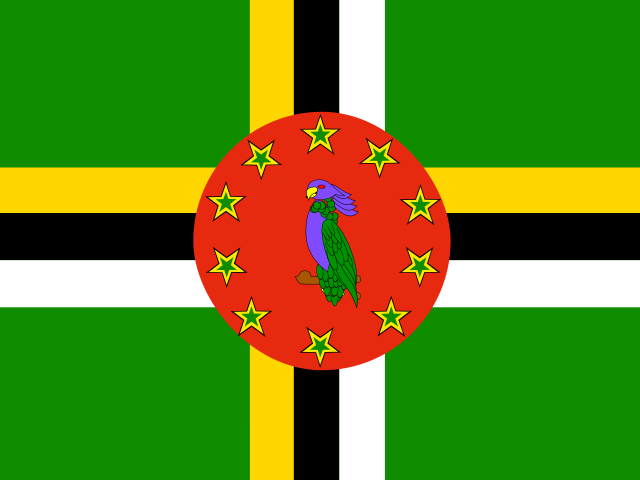
Flag of Dominica
The 10 stars represent the 10 administrative divisions (parishes).
Look for the parrot before counting the stars. Dominica is the green flag with a bird inside a red disc.
Languages and local life
Where the name comes from The island was named by explorer Christopher COLUMBUS for the day of the week on which he spotted it, Sunday ("Domingo" in Latin), 3 November 1493.
Language profile English (official), French patois.
Currency Eastern Caribbean dollar (XCD).
Borders and landscape
Area and borders Total area is about 751 km².
Landscape Rugged mountains of volcanic origin.
From high to low Highest point: Morne Diablotins 1,447 m. Lowest point: Caribbean Sea 0 m.
Where it is
On the map Dominica sits between two French Caribbean islands and contains a geothermal lake in its mountainous interior.
Where people live Population is mosly clustered along the coast, with roughly a third living in the parish of St. George, in or around the capital of Roseau; the volcanic interior is sparsely populated.
A person connected to this country
Profile Jean Rhys ( REESS; born Ella Gwendoline Rees Williams; 24 August 1890 – 14 May 1979) was a British Creole novelist who was born and grew up in the Caribbean island of Dominica. From the age of 16, she resided mainly in England, where she was sent for her education.
From the biography “She is best known for her final novel, Wide Sargasso Sea (1966), written as a prequel to Charlotte Brontë's Jane Eyre.”