
Dominican Republic
The Dominican Republic shares Hispaniola with Haiti and contains the highest mountains on the island.
- Capital
- Santo Domingo
- Region
- Caribbean
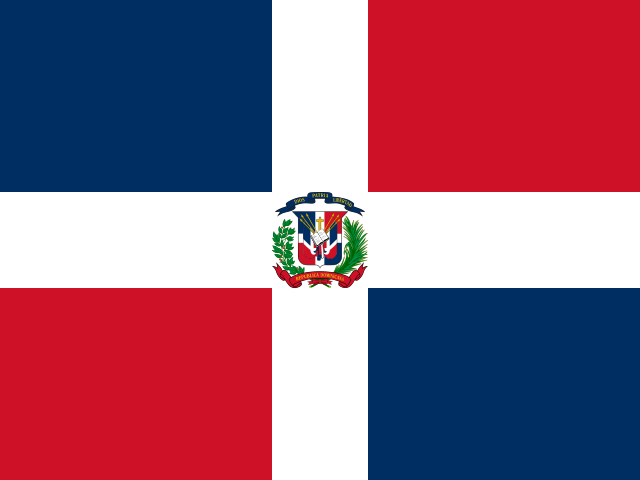
Flag of Dominican Republic
Blue stands for liberty, white for salvation, and red for the blood of heroes.
Red and blue alternate around a white cross. The small coat of arms sits right where the white bands meet.
Languages and local life
Where the name comes from The country name derives from the capital city of Santo Domingo (Saint Dominic).
Language profile Spanish (official).
Currency Dominican peso (DOP).
Borders and landscape
Area and borders Total area is about 48,671 km². It shares land borders with Haiti.
Landscape Rugged highlands and mountains interspersed with fertile valleys.
From high to low Highest point: Pico Duarte 3,098 m. Lowest point: Lago Enriquillo -46 m.
Where it is
On the map The Dominican Republic shares Hispaniola with Haiti and contains the highest mountains on the island.
Where people live Coastal development is significant, especially in the southern coastal plains and the Cibao Valley, where population density is highest; smaller population clusters exist in the interior mountains (Cordillera Central).
A person connected to this country
Profile Juan Luis Guerra Seijas (born 7 June 1957) is a Dominican musician, singer, composer, and record producer. Throughout his career, he has won numerous awards including 31 Latin Grammy Awards, three
Taking bachata abroad Guerra brought bachata to an international audience. In some songs he combines its bolero roots with harmonies and melodies influenced by bossa nova.