
Eritrea
Eritrea extends along the Red Sea from Sudan toward Djibouti, and the Dahlak islands sit off its coast.
- Capital
- Asmara
- Region
- Eastern Africa
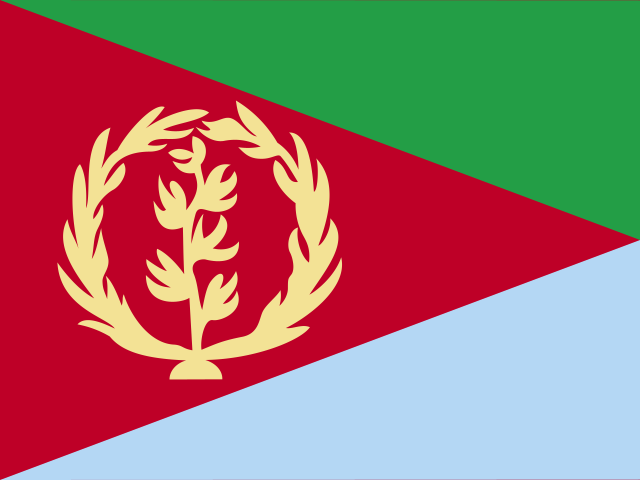
Flag of Eritrea
Green stands for the country's agriculture economy, red signifies the blood shed in the fight for freedom, and blue symbolizes the bounty of the sea.
Picture the gold wreath inside the red triangle. The red opens from a wide edge at the left to a point on the right.
Languages and local life
Where the name comes from The country name derives from the ancient Greek appellation "Erythra Thalassa" meaning Red Sea, which is the major water body bordering the country.
Language profile Tigrinya (official), Arabic (official), English (official), Tigre, Kunama, Afar, other Cushitic languages.
Currency Eritrean nakfa (ERN).
Borders and landscape
Area and borders Total area is about 117,600 km². It shares land borders with Djibouti, Ethiopia and Sudan.
Landscape Dominated by extension of Ethiopian north-south trending highlands, descending on the east to a coastal desert plain, on the northwest to hilly terrain and on the southwest to flat-to-rolling plains.
From high to low Highest point: Soira 3,018 m. Lowest point: near Kulul within the Danakil Depression -75 m.
Where it is
On the map Eritrea extends along the Red Sea from Sudan toward Djibouti, and the Dahlak islands sit off its coast.
Where people live Density is highest in the center of the country in and around the cities of Asmara (capital) and Keren; smaller settlements exist in the north and south.
A person connected to this country
Profile Isaias Afwerki (Tigrinya: ኢሳይያስ ኣፍወርቂ, pronounced [isajas afwɐrkʼi], ; born 2 February 1946) is an Eritrean politician who has served as the president and dictator of Eritrea since its independence in 1993 and the chairman of the People's Front for Democracy and Justice (PFDJ) since 1994.
From the biography “The United Nations and human rights organizations such as Amnesty International and Freedom House have cited him for human rights violations.”