
Guinea-Bissau
Guinea-Bissau combines a low Atlantic mainland with the Bijagós Archipelago offshore.
- Capital
- Bissau
- Region
- Western Africa
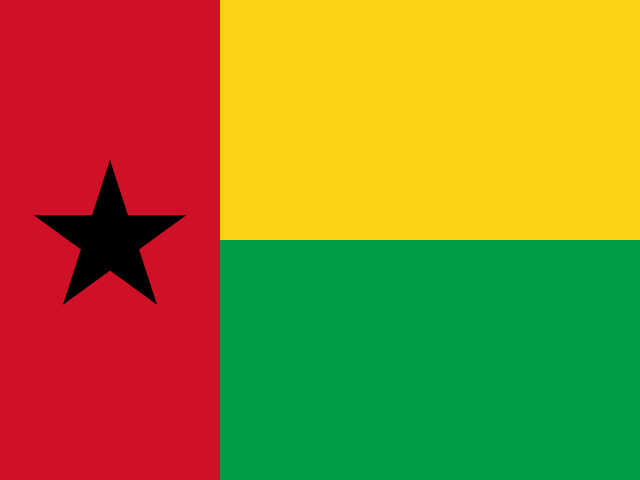
Flag of Guinea-Bissau
The black star stands for African unity, and red recalls the struggle for independence.
The black star sits on the red block at the left. Ghana puts its black star in the middle of a yellow stripe.
Languages and local life
Where the name comes from The country is named after the Guinea region of West Africa that lies along the Gulf of Guinea and stretches north to the Sahel; "Bissau," the name of the capital city, distinguishes the country from neighboring Guinea.
Language profile Portuguese-based Creole, Portuguese (official; largely used as a second or third language), Pular (a Fula language), Mandingo.
Currency West African CFA franc (XOF).
Borders and landscape
Area and borders Total area is about 36,125 km². It shares land borders with Guinea and Senegal.
Landscape Mostly low-lying coastal plain with a deeply indented estuarine coastline rising to savanna in east; numerous off-shore islands including the Arquipelago Dos Bijagos consisting of 18 main islands and many small islets.
From high to low Highest point: Dongol Ronde 277 m. Lowest point: Atlantic Ocean 0 m.
Where it is
On the map Guinea-Bissau combines a low Atlantic mainland with the Bijagós Archipelago offshore.
Where people live Approximately one-fifth of the population lives in the capital city of Bissau along the Atlantic coast; the remainder is distributed among the eight other, mainly rural, regions.
A person connected to this country
Profile Amílcar Lopes Cabral (Portuguese: [ɐˈmilkaɾ ˈlɔpɨʃ kɐˈbɾal]; (1924-09-12)12 September 1924 – (1973-01-20)20 January 1973) was a Bissau-Guinean and Cape Verdean agricultural engineer, political organizer, diplomat, and half-brother of Luís Cabral. He was widely remembered as one of Africa's foremost anti-colonial leaders.
From the biography “He was also a pan-Africanist and intellectual nationalist revolutionary poet.”