
India
India's peninsula projects south between those seas, while the Himalayas mark much of its northern edge.
- Capital
- New Delhi
- Region
- Southern Asia
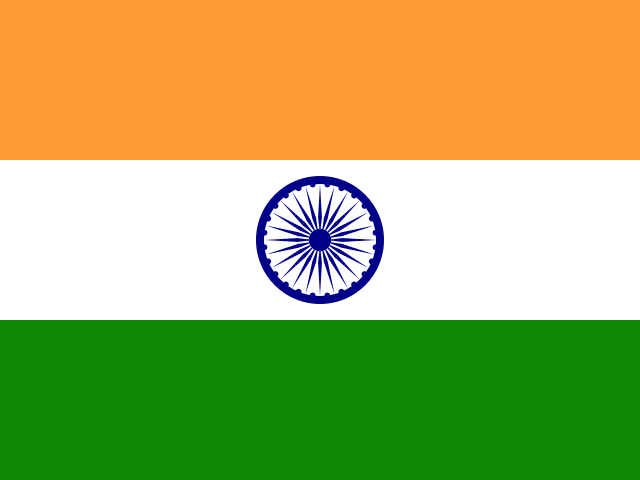
Flag of India
The 24-spoke Ashoka Chakra comes from the Lion Capital of Ashoka and represents the wheel of dharma.
The dark blue wheel is the cue. Niger uses similar colours around a white centre, but puts a solid orange disc there.
Languages and local life
Where the name comes from The English name derives from the Indus River; the Indian name "Bharat" may derive from the "Bharatas" tribe mentioned in the Vedas of the second millennium B.C.; the name is also associated with Emperor Bharata, the legendary conqueror of all of India.
Language profile Hindi 43.6%, Bengali 8%, Marathi 6.9%, Telugu 6.7%, Tamil 5.7%, Gujarati 4.6%, Urdu 4.2%, Kannada 3.6%, Odia 3.1%, Malayalam 2.9%, Punjabi 2.7%, Assamese 1.3%, Maithili 1.1%, other 5.6%; English is the subsidiary official language but is the most important one for national, political, and commercial communication (2011 est.).
Currency Indian rupee (INR).
Borders and landscape
Area and borders Total area is about 3,287,590 km². It shares land borders with Bangladesh, Bhutan, Myanmar, China, Nepal and Pakistan.
Landscape Upland plain (Deccan Plateau) in south, flat to rolling plain along the Ganges, deserts in west, Himalayas in north.
From high to low Highest point: Kanchenjunga 8,586 m. Lowest point: Indian Ocean 0 m.
A moment in its history
The event India’s independence movement sought to end British colonial rule and culminated in the transfer of power in 1947.
The wider story The movement’s methods changed over time, from early demands for reform to non-cooperation and civil disobedience. A founding date and a transfer-of-power date therefore bracket a changing political campaign, rather than one continuous tactic.
From reform to withdrawal The Indian National Congress began in 1885. Early leaders sought reforms such as access to civil service exams. The Quit India Movement in 1942 demanded an end to British rule.
A person connected to this country
What they contributed “for their experimental approach to alleviating global poverty”
The person Abhijit Banerjee, born in Mumbai, received the 2019 Nobel Prize in Economic Sciences.
Where they worked Massachusetts Institute of Technology (MIT) at the time of the award.
Where it is
On the map India's peninsula projects south between those seas, while the Himalayas mark much of its northern edge.
Where people live With the notable exception of the deserts in the northwest, including the Thar Desert, and the mountain fringe in the north, a very high population density exists throughout most of the country; the core of the population is in the north along the banks of the Ganges, with other river valleys and southern coastal areas also having large population concentrations.