
Kazakhstan
Kazakhstan runs across the steppe south of Russia, from the Caspian basin to mountains near China and Mongolia.
- Capital
- Astana
- Region
- Central Asia
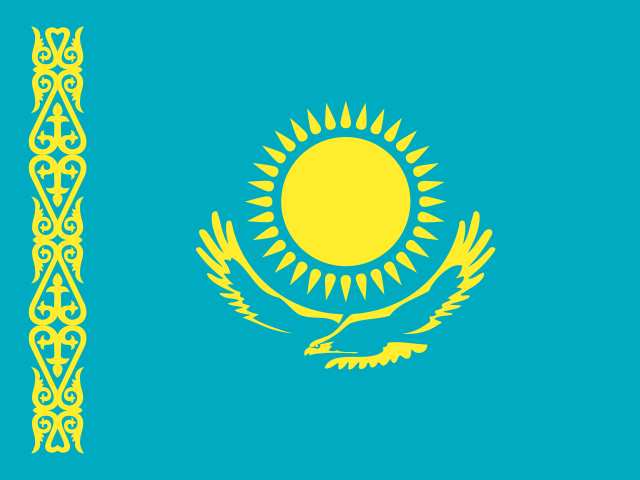
Flag of Kazakhstan
The blue color is of religious significance to the Turkic peoples of the country, and so symbolizes cultural and ethnic unity.
The eagle is flying under the sun. Rwanda also has a sun on blue, but places it in the upper-right corner without an eagle.
Compare with Nauru · Somalia · Micronesia · Palau · Rwanda.
Languages and local life
Where the name comes from The name "Kazakh" may derive from the Turkic word "kaz" meaning "to wander," recalling the Kazakh's nomadic lifestyle; the Persian suffix "-stan" means "place of" or "country," so the word Kazakhstan literally means "Land of the Wanderers".
Language profile Kazakh (official, Qazaq) 80.1%, Russian 83.7%, English 35.1% (2021 est.).
Currency Kazakhstani tenge (KZT).
Food traditions
The tradition Families and neighbours make flatbread together, sharing tasks from mixing the dough to baking. The bread is served at gatherings and life events, where sharing it can express hospitality or solidarity.
Three ways to bake The same practice can call for an earth oven, a metal plate or a cauldron. The equipment varies across the communities that share the tradition.
Borders and landscape
Area and borders Total area is about 2,724,900 km². It shares land borders with China, Kyrgyzstan, Russia, Turkmenistan and Uzbekistan.
Landscape Vast flat steppe extending from the Volga in the west to the Altai Mountains in the east and from the plains of western Siberia in the north to oases and deserts of Central Asia in the south.
From high to low Highest point: Pik Khan-Tengri 7,010 m note - the northern most 7,000 meter peak in the World. Lowest point: Qauyndy Oyysy -132 m.
Where it is
On the map Kazakhstan runs across the steppe south of Russia, from the Caspian basin to mountains near China and Mongolia.
Where people live Most of the country displays a low population density, particularly the interior; population clusters appear in urban agglomerations in the far northern and southern portions of the country.