
Liechtenstein
Liechtenstein is the small Alpine state between Switzerland and Austria, with the Rhine marking its western edge.
- Capital
- Vaduz
- Region
- Western Europe
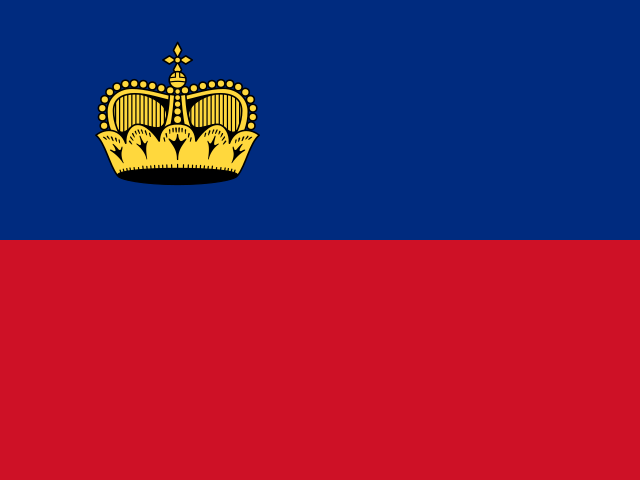
Flag of Liechtenstein
The prince’s crown was added in 1937 to distinguish the flag from Haiti’s similar blue-and-red design.
Look high and left for the gold crown. Haiti has the same blue-over-red arrangement, but its emblem sits in the middle.
Languages and local life
Where the name comes from Named after the Liechtenstein dynasty that purchased and united the counties of Schellenburg and Vaduz and that was allowed by the Holy Roman Emperor in 1719 to rename the new property after their family; the name in German means "light (bright) stone".
Language profile German 91.5% (official, Alemannic is the main dialect), Italian 1.5%, Turkish 1.3%, Portuguese 1.1%, other 4.6% (2015 est.).
Currency Swiss franc (CHF).
Borders and landscape
Area and borders Total area is about 160 km². It shares land borders with Austria and Switzerland.
Landscape Mostly mountainous (Alps) with Rhine Valley in western third.
From high to low Highest point: Vorder-Grauspitz 2,599 m. Lowest point: Ruggeller Riet 430 m.
Where it is
On the map Liechtenstein is the small Alpine state between Switzerland and Austria, with the Rhine marking its western edge.
Where people live Most of the population is found in the western half of the country along the Rhine River.
A person connected to this country
Profile Hans-Adam II (Johannes Adam Ferdinand Alois Josef Maria Marco d'Aviano Pius; born 14 February 1945) is the Prince of Liechtenstein, reigning since 1989. As a member of the Liechtenstein princely family, he also holds the title of Duke of Troppau and Jägerndorf and Count of Rietberg.
Learning to govern Franz Joseph II handed his son the day-to-day duties of the monarchy in 1984. Hans-Adam served as regent for five years before succeeding his father.