
Mali
Mali stretches from the Sahara into the Sahel, where Timbuktu sits near the great curve of the Niger River.
- Capital
- Bamako
- Region
- Western Africa
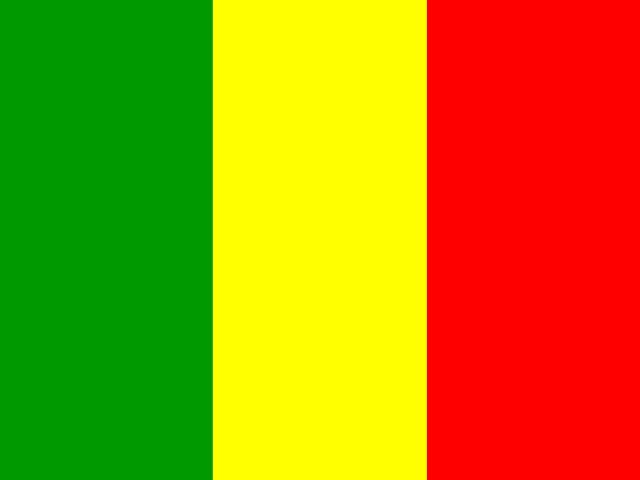
Flag of Mali
Green, yellow and red are Pan-African colours.
Think Senegal with the green star removed. Mali keeps the green–yellow–red order, while Guinea reverses it.
Languages and local life
Where the name comes from Name derives from the West African Mali Empire of the 13th to 16th centuries A.D.
Language profile Bambara (official), French 17.2%, Peuhl/Foulfoulbe/Fulani 9.4%, Dogon 7.2%, Maraka/Soninke 6.4%, Malinke 5.6%, Sonrhai/Djerma 5.6%, Minianka 4.3%, Tamacheq 3.5%, Senoufo 2.6%, Bobo 2.1%, other 6.3%, unspecified 0.7% (2009 est.).
Currency West African CFA franc (XOF).
Borders and landscape
Area and borders Total area is about 1,240,192 km². It shares land borders with Algeria, Burkina Faso, Guinea, Ivory Coast, Mauritania, Niger and Senegal.
Landscape Mostly flat to rolling northern plains covered by sand; savanna in south, rugged hills in northeast.
From high to low Highest point: Hombori Tondo 1,155 m. Lowest point: Senegal River 23 m.
Where it is
On the map Mali stretches from the Sahara into the Sahel, where Timbuktu sits near the great curve of the Niger River.
Where people live The overwhelming majority of the population lives in the southern half of the country, with greater density along the border with Burkina Faso.
A person connected to this country
Profile Salif Keïta (IPA: [salif keita]) (born 25 August 1949) is a Malian singer-songwriter, referred to as the "Golden Voice of Africa". He is a member of the Keita royal family of Mali.
Music beyond Mali With the 1987 album Soro, Keïta brought his music to a wider audience. Its success led to an invitation to perform in London at the concert marking Nelson Mandela’s 70th birthday.