
Mongolia
Mongolia lies between Russia and China, and the Gobi extends across its south into China. Much of this desert is rocky rather than sandy. Its dryness has a distant cause: the Himalayas block moisture arriving from the Indian Ocean, leaving the Gobi in a rain shadow. A desert landscape can therefore reflect mountains far beyond its own horizon.
- Capital
- Ulan Bator
- Region
- Eastern Asia
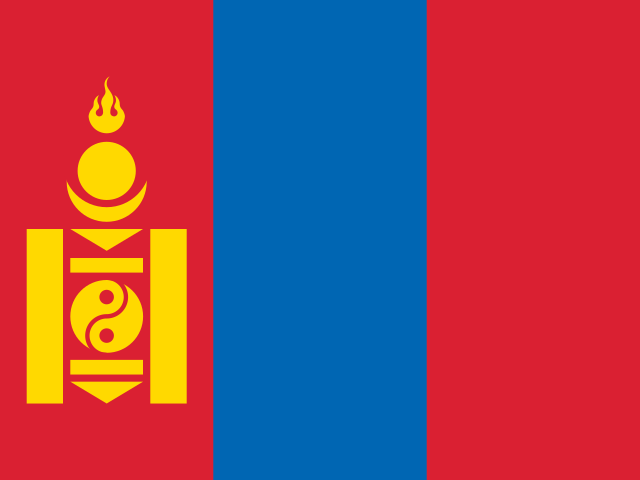
Flag of Mongolia
Blue represents the sky, red symbolizes progress and prosperity.
Look for the gold Soyombo on the left, with a flame at the top and a crescent below. The red stripe on the right stays plain.
Languages and local life
Where the name comes from The name means "Land of the Mongols" in Latin; the Mongolian name Mongol Uls translates as "Mongol State".
Language profile Mongolian 90% (official, Khalkha dialect is predominant), Turkic, Russian (1999).
Currency Mongolian tögrög (MNT).
Borders and landscape
Area and borders Total area is about 1,564,110 km². It shares land borders with China and Russia.
Landscape Vast semidesert and desert plains, grassy steppe, mountains in west and southwest; Gobi Desert in south-central.
From high to low Highest point: Nayramadlin Orgil (Khuiten Peak) 4,374 m. Lowest point: Hoh Nuur 560 m.
Where it is
On the map Mongolia lies between Russia and China, and the Gobi extends across its south into China. Much of this desert is rocky rather than sandy. Its dryness has a distant cause: the Himalayas block moisture arriving from the Indian Ocean, leaving the Gobi in a rain shadow. A desert landscape can therefore reflect mountains far beyond its own horizon.
Where people live Sparsely distributed population throughout the country; the capital of Ulaanbaatar and the northern city of Darhan support the highest population densities.
A person connected to this country
Profile Genghis Khan (born Temüjin; c. 1162 – 18 or 25 August 1227), also known as Chinggis Khan, was the founder and first khan of the Mongol Empire. After spending most of his life uniting the Mongol tribes, he launched a series of military campaigns, conquering large parts of China and Central Asia.
From the biography “When Temüjin was eight, his father died and his family was abandoned by its tribe.”