
Montenegro
Montenegro's coast includes the Bay of Kotor, while the Tara canyon lies in its Dinaric mountain interior.
- Capital
- Podgorica
- Region
- Southeast Europe
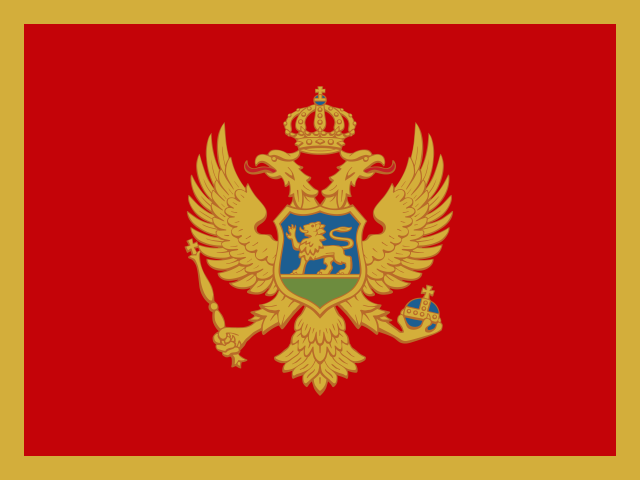
Flag of Montenegro
The gold double-headed eagle comes from Montenegro’s coat of arms.
Find the gold frame first. Inside it is a gold double-headed eagle. Albania’s eagle is black, with no frame around the flag.
Compare with Albania.
Languages and local life
Where the name comes from The country's name locally as well as in most Western European languages means "black mountain" and refers to the dark coniferous forests on Mount Lovcen and the surrounding area.
Language profile Serbian 42.9%, Montenegrin (official) 37%, Bosnian 5.3%, Albanian 5.3%, Serbo-Croat 2%, other 3.5%, unspecified 4% (2011 est.).
Currency Euro (EUR).
Borders and landscape
Mountains and coast In Montenegro, deep river canyons cut through the mountainous interior, while a narrow coastal plain meets the Adriatic. Its name, Crna Gora, means ‘Black Mountain’ and was first used for part of those highlands.
Area and borders Total area is about 13,812 km². It shares land borders with Albania, Bosnia and Herzegovina, Croatia, Kosovo and Serbia.
Landscape Highly indented coastline with narrow coastal plain backed by rugged high limestone mountains and plateaus.
Where it is
On the map Montenegro's coast includes the Bay of Kotor, while the Tara canyon lies in its Dinaric mountain interior.
Where people live Highest population density is concentrated in the south, southwest; the extreme eastern border is the least populated area.
A person connected to this country
Profile Petar II Petrović-Njegoš (Serbian Cyrillic: Петар II Петровић-Његош, pronounced [pětar drûɡi pětroʋitɕ ɲêɡoʃ]; 13 November [O.S. 1 November] 1813 – 31 October [O.S.
From the biography “Njegoš was born in the village of Njeguši, near Montenegro's then-capital Cetinje.”