
New Zealand
New Zealand's North and South islands lie on either side of Cook Strait, with the Southern Alps running along the South Island.
- Capital
- Wellington
- Region
- Australia and New Zealand
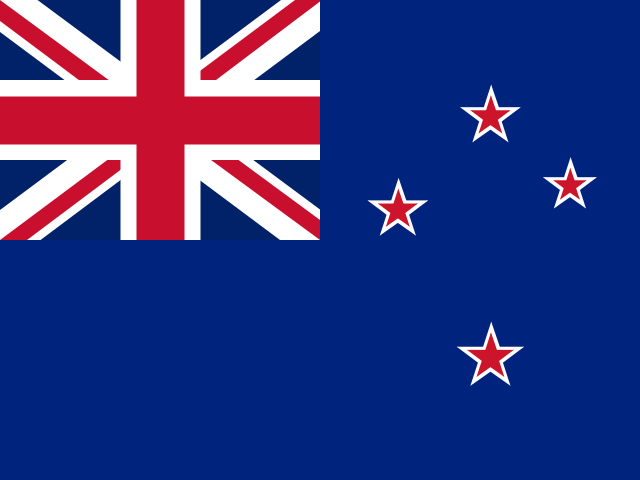
Flag of New Zealand
The stars on New Zealand’s flag depict the Southern Cross. The design grew out of a maritime ensign and became the official national flag in 1902.
Count four red stars edged in white. Australia’s stars are white, including a large extra star under the Union Jack.
Languages and local life
Where the name comes from Dutch explorer Abel TASMAN was the first European to reach New Zealand in 1642; he named it Staten Landt, but Dutch cartographers renamed it Nova Zeelandia in 1645 after the Dutch province of Zeeland; British explorer Captain James COOK subsequently anglicized the name to New Zealand when he mapped the islands in 1769.
Language profile English (de facto official) 95.4%, Maori (de jure official) 4%, Samoan 2.2%, Northern Chinese 2%, Hindi 1.5%, French 1.2%, Yue 1.1%, New Zealand Sign Language (de jure official) 0.5%, other or not stated 17.2% (2018 est.).
Currency New Zealand dollar (NZD).
Borders and landscape
Area and borders Total area is about 270,467 km².
Landscape Predominately mountainous with large coastal plains.
From high to low Highest point: Aoraki/Mount Cook 3,724 m; note - the mountain's height was 3,764 m until 14 December 1991 when it lost about 10 m in an avalanche of rock and ice; erosion of the ice cap since then has brought the height down another 30 m. Lowest point: Pacific Ocean 0 m.
A moment in its history
The event New Zealand became the Dominion of New Zealand on 26 September 1907 by proclamation of King Edward VII.
The wider story New Zealand had already received responsible government in 1852 and had declined to join Australian federation. In 1907, the Dominion title marked a relationship that had evolved over decades; Britain still shaped its foreign policy.
Why dominion status mattered New Zealand became a separate British Crown colony in 1841 and gained responsible government in the 1850s. Dominion status in 1907 marked a further stage in that evolution.
A person connected to this country
What they contributed “for the discovery and development of conductive polymers”
The person Alan MacDiarmid, born in Masterton, received the 2000 Nobel Prize in Chemistry.
Where they worked University of Pennsylvania at the time of the award.
Where it is
On the map New Zealand's North and South islands lie on either side of Cook Strait, with the Southern Alps running along the South Island.
Where people live Over three-quarters of New Zealanders, including the indigenous Maori, live on the North Island, primarily in urban areas.