
Nicaragua
Nicaragua spans the Central American isthmus and contains the large lake in which Ometepe rises.
- Capital
- Managua
- Region
- Central America
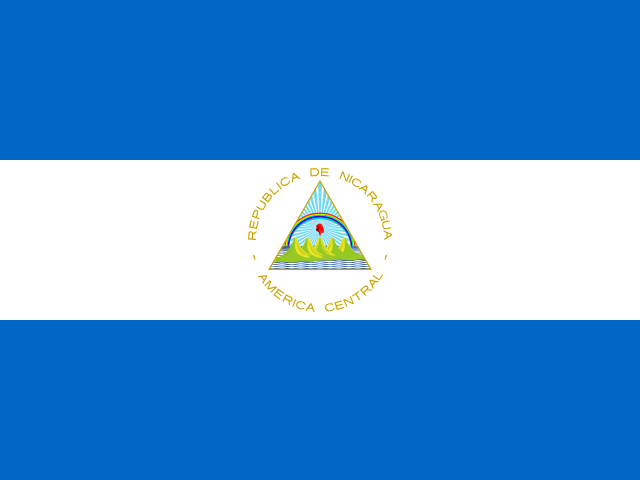
Flag of Nicaragua
The blue bands symbolize the Pacific Ocean and the Caribbean Sea, while the white band represents the land between the two bodies of water.
Inside Nicaragua’s blue–white–blue is a triangle in a ring of lettering. Honduras has five blue stars instead.
Compare with El Salvador · Honduras · San Marino · Guatemala.
Languages and local life
Where the name comes from Nicarao was the name of the largest indigenous settlement at the time of Spanish arrival; conquistador Gil GONZALEZ Davila, who explored the area (1622-23), combined the name of the community with the Spanish word "agua" (water), referring to the two large lakes in the west of the country (Lake Managua and Lake Nicaragua).
Language profile Spanish (official) 99.5%, Indigenous 0.3%, Portuguese 0.1%, other 0.1% (2020 est.).
Currency Nicaraguan córdoba (NIO).
Borders and landscape
Area and borders Total area is about 130,373 km². It shares land borders with Costa Rica and Honduras.
Landscape Extensive Atlantic coastal plains rising to central interior mountains; narrow Pacific coastal plain interrupted by volcanoes.
From high to low Highest point: Mogoton 2,085 m. Lowest point: Pacific Ocean 0 m.
Where it is
On the map Nicaragua spans the Central American isthmus and contains the large lake in which Ometepe rises.
Where people live The overwhelming majority of the population resides in the western half of the country, with much of the urban growth centered in the capital city of Managua; coastal areas also show large population clusters.
A person connected to this country
Profile Félix Rubén García Sarmiento (18 January 1867 – 6 February 1916), known as Rubén Darío (US: dah-REE-oh, Spanish: [ruˈβen daˈɾi.o]), was a Nicaraguan poet who initiated the Spanish-language literary movement known as modernismo (modernism) that flourished at the end of the 19th century. Darío had a great and lasting influence on 20th-century Spanish-language literature and journalism.
A book that crossed borders Darío’s Azul… was published in Valparaíso, Chile, in 1888. The Chilean National Library identifies it as a starting point of Spanish-American literary modernismo.