
Oman
Oman's Musandam Peninsula reaches the Strait of Hormuz but is separated from the country's main territory by the United Arab Emirates. It is an exclave: national territory detached from the main part. Oman also has the smaller Madha exclave within the UAE. To recognise this country, a single continuous outline is therefore not enough.
- Capital
- Muscat
- Region
- Western Asia
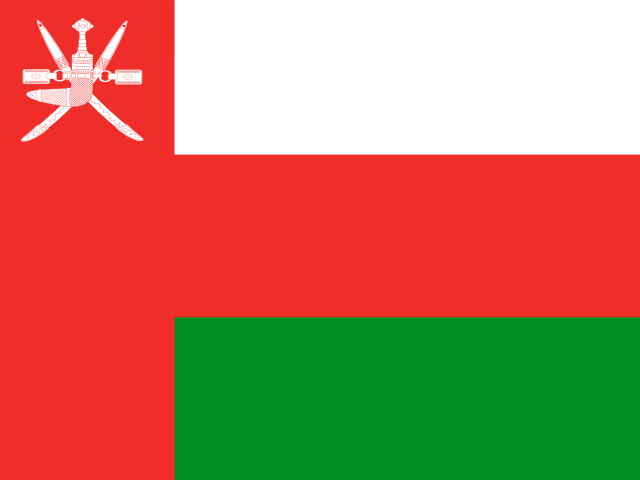
Flag of Oman
White represents peace and prosperity, red recalls battles against foreign invaders, and green symbolizes the Jebel al Akhdar (Green Mountains) and fertility.
The left red band carries a dagger over two crossed swords. The smaller stripes to its right run white, red, green.
Languages and local life
Where the name comes from The origin of the name is uncertain, but it apparently dates back at least 2,000 years since an "Omana" is mentioned by Pliny the Elder (1st century A.D.) and an "Omanon" by Ptolemy (2nd century A.D.).
Language profile Arabic (official), English, Baluchi, Swahili, Urdu, Indian dialects.
Currency Omani rial (OMR).
Food traditions
The tradition Date palms provide food, but their value extends beyond the fruit. Communities use the fronds for weaving and pass down knowledge of pollination, harvesting and other work that keeps the groves productive.
Culture in the oasis The palm thrives where water is available for irrigation. Alongside its role in crafts and food, the tree is remembered in poetry and song.
Borders and landscape
Area and borders Total area is about 309,500 km². It shares land borders with Saudi Arabia, United Arab Emirates and Yemen.
Landscape Central desert plain, rugged mountains in north and south.
From high to low Highest point: Jabal Shams 3,004 m. Lowest point: Arabian Sea 0 m.
Where it is
On the map Oman's Musandam Peninsula reaches the Strait of Hormuz but is separated from the country's main territory by the United Arab Emirates. It is an exclave: national territory detached from the main part. Oman also has the smaller Madha exclave within the UAE. To recognise this country, a single continuous outline is therefore not enough.
Where people live The vast majority of the population is located in and around the Al Hagar Mountains in the north of the country; another smaller cluster is found around the city of Salalah in the far south; most of the country remains sparsely poplulated.