
Papua New Guinea
Papua New Guinea shares the island of New Guinea with Indonesia and includes New Britain in the Bismarck Archipelago.
- Capital
- Port Moresby
- Region
- Melanesia
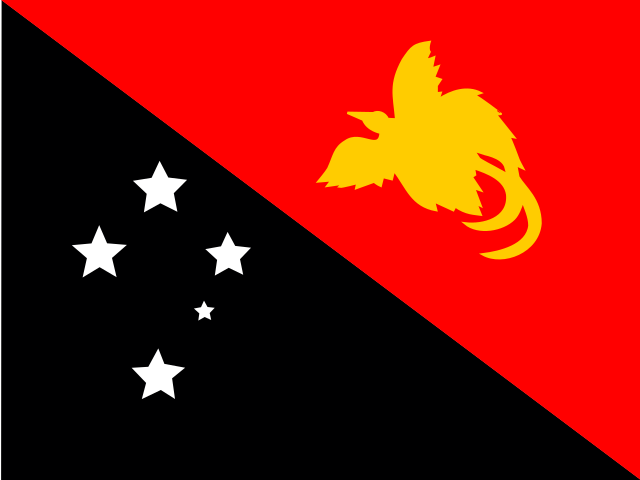
Flag of Papua New Guinea
The bird of paradise - endemic to the island of New Guinea - is an emblem of regional tribal culture and represents the emergence of Papua New Guinea as a nation.
A diagonal splits the bird and the stars: gold bird on the red upper half, white stars on the black lower half.
Languages and local life
Where the name comes from The word "papua" derives from the Malay "papuah" describing the frizzy hair of the Melanesians; Spanish explorer Ynigo ORTIZ de RETEZ applied the term "Nueva Guinea" to the island of New Guinea in 1545 after noting the resemblance of the locals to the peoples of the Guinea coast of Africa.
Language profile Tok Pisin (official), English (official), Hiri Motu (official), some 839 living indigenous languages are spoken (about 12% of the world's total).
Currency Papua New Guinean kina (PGK).
Borders and landscape
Area and borders Total area is about 462,840 km². It shares land borders with Indonesia.
Landscape Mostly mountains with coastal lowlands and rolling foothills.
From high to low Highest point: Mount Wilhelm 4,509 m. Lowest point: Pacific Ocean 0 m.
Where it is
On the map Papua New Guinea shares the island of New Guinea with Indonesia and includes New Britain in the Bismarck Archipelago.
Where people live Population concentrated in the highlands and eastern coastal areas on the island of New Guinea; predominantly a rural distribution with only about one-fifth of the population residing in urban areas.
A person connected to this country
Profile Sir Michael Thomas Somare (9 April 1936 – 25 February 2021) was a Papua New Guinean politician. Widely called the "father of the nation" (Tok Pisin: Papa blo kantri), he was the first Prime Minister after independence.
From the biography “His political career spanned from 1968 until his retirement in 2017.”