
Philippines
The Philippines is the western Pacific archipelago whose two largest islands, Luzon and Mindanao, anchor its north and south.
- Capital
- Manila
- Region
- South-Eastern Asia
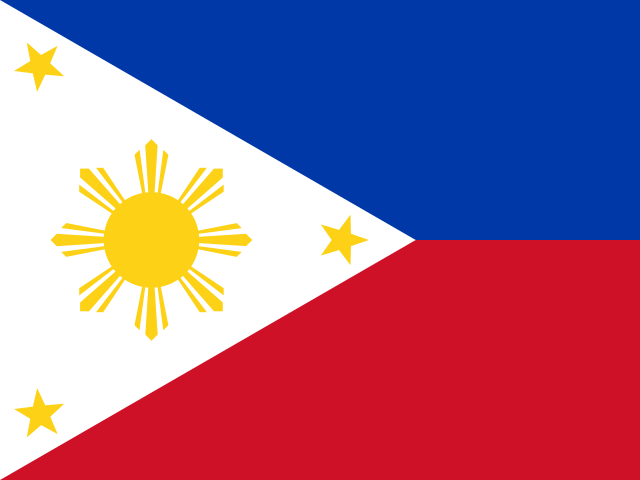
Flag of Philippines
The sun’s eight rays honour the first provinces to rise against Spain. The stars represent Luzon, Visayas and Mindanao.
Look for one star in each corner of the white triangle, with a sun between them. Cuba has only one star in its triangle.
Languages and local life
Where the name comes from Named in honor of King PHILLIP II of Spain by Spanish explorer Ruy LOPEZ de VILLALOBOS, who visited some of the islands in 1543.
Language profile Tagalog 39.9%, Bisaya/Binisaya 16%, Hiligaynon/Ilonggo 7.3%, Ilocano 7.1%, Cebuano 6.5%, Bikol/Bicol 3.9%, Waray 2.6%, Kapampangan 2.4%, Maguindanao 1.4%, Pangasinan/Panggalato 1.3%, other languages/dialects 11.2%, unspecified 0.4% (2020 est.).
Currency Philippine peso (PHP).
Borders and landscape
Area and borders Total area is about 342,353 km².
Landscape Mostly mountains with narrow to extensive coastal lowlands.
From high to low Highest point: Mount Apo 2,954 m. Lowest point: Philippine Sea 0 m.
A person connected to this country
What they contributed “for their efforts to safeguard freedom of expression, which is a precondition for democracy and lasting peace”
The person Maria Ressa, born in Manila, received the 2021 Nobel Prize in Peace.
Where it is
On the map The Philippines is the western Pacific archipelago whose two largest islands, Luzon and Mindanao, anchor its north and south.
Where people live Population concentrated where good farmlands lie; highest concentrations are northwest and south-central Luzon, the southeastern extension of Luzon, and the islands of the Visayan Sea, particularly Cebu and Negros; Manila is home to one-eighth of the entire national population.