
Poland
Poland extends from the southern mountains to the Baltic coast, with the Vistula reaching the sea near Gdańsk.
- Capital
- Warsaw
- Region
- Central Europe
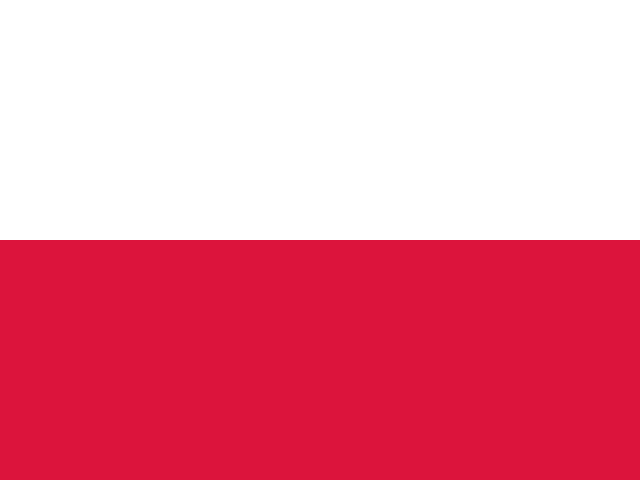
Flag of Poland
White and red come from Poland’s traditional coat of arms, a white eagle on a red shield.
White above red is Poland. Turn it upside down and you have the shared layout of Indonesia and Monaco.
Languages and local life
Where the name comes from Name derives from the Polanians, a west Slavic tribe that united several surrounding Slavic groups (9th-10th centuries A.D.) and who passed on their name to the country; the name of the tribe likely comes from the Slavic "pole" (field or plain), indicating the flat nature of their country.
Language profile Polish (official) 98.2%, Silesian 1.4%, other 1.1%, unspecified 1.2% (2011 est.).
Currency Polish złoty (PLN).
Borders and landscape
Area and borders Total area is about 312,679 km². It shares land borders with Belarus, Czechia, Germany, Lithuania, Russia, Slovakia and Ukraine.
Landscape Mostly flat plain; mountains along southern border.
From high to low Highest point: Rysy 2,499 m. Lowest point: near Raczki Elblaskie -2 m.
A person connected to this country
What they contributed “for a narrative imagination that with encyclopedic passion represents the crossing of boundaries as a form of life”
The person Olga Tokarczuk, born in Sulechów, received the 2018 Nobel Prize in Literature.
Where it is
On the map Poland extends from the southern mountains to the Baltic coast, with the Vistula reaching the sea near Gdańsk.
Where people live Population concentrated in the southern area around Krakow and the central area around Warsaw and Lodz, with an extension to the northern coastal city of Gdansk.