
Saint Lucia
Saint Lucia sits between Martinique and Saint Vincent in the eastern Caribbean, and the Pitons rise on its southwestern side.
- Capital
- Castries
- Region
- Caribbean
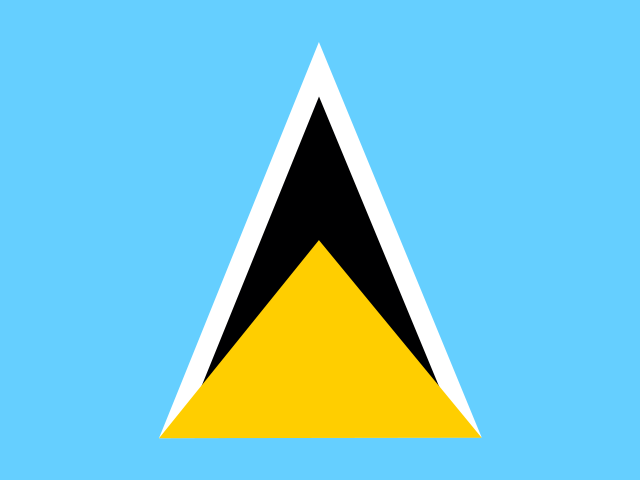
Flag of Saint Lucia
The blue color represents the sky and sea, gold stands for sunshine and prosperity, and white and black the racial composition of the island (with the latter being dominant).
Find the pointed black-and-white peak rising out of the yellow triangle. Both shapes sit in a field of sky blue.
Languages and local life
Where the name comes from Named after Saint LUCY of Syracuse by French sailors who were shipwrecked on the island on 13 December 1502, the saint's feast day; Saint Lucia is the only country named specifically after a woman.
Language profile English (official), Saint Lucian Creole.
Currency Eastern Caribbean dollar (XCD).
Borders and landscape
Area and borders Total area is about 616 km².
Landscape Volcanic and mountainous with broad, fertile valleys.
From high to low Highest point: Mount Gimie 948 m. Lowest point: Caribbean Sea 0 m.
A person connected to this country
What they contributed “for a poetic oeuvre of great luminosity, sustained by a historical vision, the outcome of a multicultural commitment”
The person Derek Walcott, born in Castries, received the 1992 Nobel Prize in Literature.
Where it is
On the map Saint Lucia sits between Martinique and Saint Vincent in the eastern Caribbean, and the Pitons rise on its southwestern side.
Where people live Most of the population is found on the periphery of the island, with a larger concentration in the north around the capital of Castries.