
Samoa
Samoa occupies the western part of the island chain, where Savai‘i and Upolu form most of the land area.
- Capital
- Apia
- Region
- Polynesia
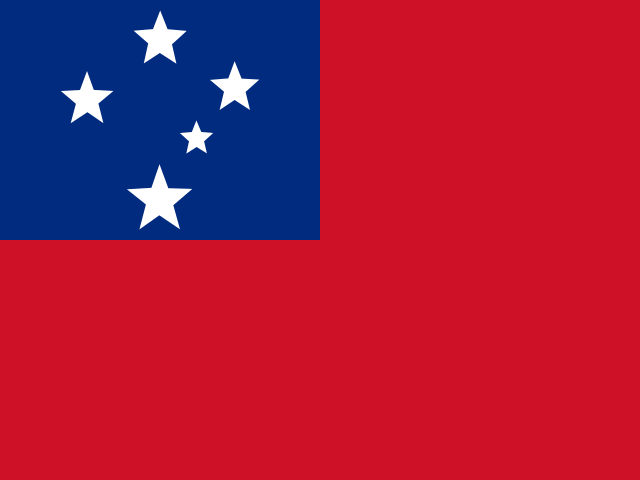
Flag of Samoa
The five white stars represent the Southern Cross, a constellation visible in the southern sky.
The white stars stay inside a blue corner box. New Zealand also has Southern Cross stars, but its corner box is the Union Jack.
Languages and local life
Where the name comes from The meaning of Samoa is disputed; some modern explanations are that the "sa" connotes "sacred" and "moa" indicates "center," so the name can mean "Holy Center"; alternatively, some assertions state that it can mean "place of the sacred moa bird" of Polynesian mythology; the name, however, may go back to Proto-Polynesian (PPn) times (before 1000 B.C.); a plausible PPn reconstruction has the first syllable as "sa'a" meaning "tribe or people" and "moa" meaning "deep sea or ocean" to convey the meaning "people of the deep sea".
Language profile Samoan (Polynesian) (official) 91.1%, Samoan/English 6.7%, English (official) 0.5%, other 0.2%, unspecified 1.6% (2006 est.).
Currency Samoan tālā (WST).
Borders and landscape
Area and borders Total area is about 2,842 km².
Landscape Two main islands (Savaii, Upolu) and several smaller islands and uninhabited islets; narrow coastal plain with volcanic, rugged mountains in interior.
From high to low Highest point: Mount Silisili 1,857 m. Lowest point: Pacific Ocean 0 m.
Where it is
On the map Samoa occupies the western part of the island chain, where Savai‘i and Upolu form most of the land area.
Where people live About three-quarters of the population lives on the island of Upolu.
A person connected to this country
Profile Malietoa Tanumafili II (4 January 1913 – 11 May 2007) was O le Ao o le Malo (head of state) of Samoa from its independence in 1962 until his death in 2007. He was bestowed with the Malietoa title in 1940 and had previously worked for the New Zealand administration as a civil servant and parliamentarian.
From the biography “As head of state, he initially served jointly with Tupua Tamasese Meaʻole, who died in April 1963.”