
South Sudan
South Sudan occupies part of the upper White Nile basin, including the Sudd, and borders Uganda to the south.
- Capital
- Juba
- Region
- Middle Africa
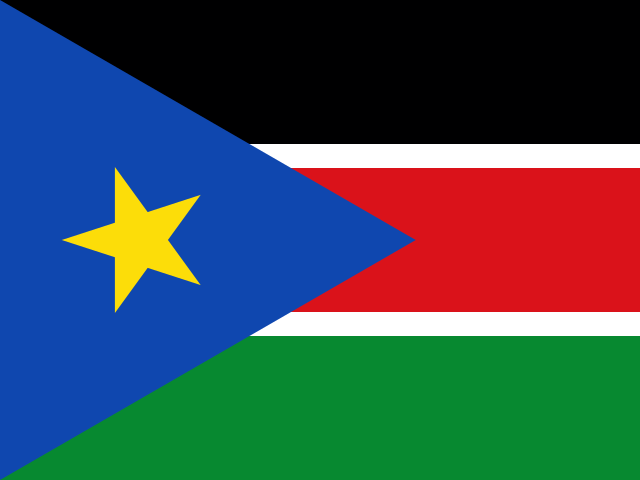
Flag of South Sudan
Black represents the people of South Sudan, red the blood shed in the struggle for freedom, green the verdant land, and blue the waters of the Nile.
Look for the yellow star in the blue triangle. Kenya and Malawi share the black, red and green bands but have no blue triangle.
Languages and local life
Where the name comes from Self-descriptive name from the country's former position within Sudan prior to independence; the name "Sudan" derives from the Arabic "bilad-as-sudan" meaning "Land of the Black [peoples]".
Language profile English (official), Arabic (includes Juba and Sudanese variants), ethnic languages include Dinka, Nuer, Bari, Zande, Shilluk.
Currency South Sudanese pound (SSP).
Borders and landscape
Area and borders Total area is about 619,745 km². It shares land borders with Central African Republic, DR Congo, Ethiopia, Kenya, Sudan and Uganda.
Landscape Plains in the north and center rise to southern highlands along the border with Uganda and Kenya; the White Nile, flowing north out of the uplands of Central Africa, is the major geographic feature of the country; The Sudd (a name derived from floating vegetation that hinders navigation) is a large swampy area of more than 100,000 sq km fed by the waters of the White Nile that dominates the center of the country.
From high to low Highest point: Kinyeti 3,187 m. Lowest point: White Nile 381 m.
Where it is
On the map South Sudan occupies part of the upper White Nile basin, including the Sudd, and borders Uganda to the south.
Where people live Clusters found in urban areas, particularly in the western interior and around the White Nile.
A person connected to this country
Profile Salva Kiir Mayardit (born 13 September 1951) is a South Sudanese politician who has served as the President of South Sudan since its independence on 9 July 2011. Prior to independence, he was the President of the Government of Southern Sudan, as well as First Vice President of Sudan, from 2005 to 2011.
From the biography “He was named Commander-in-Chief of the Sudan People's Liberation Army (SPLA) in 2005, following the death of John Garang.”