
Spain
Spain covers much of Iberia and extends offshore to the Balearics in the western Mediterranean.
- Capital
- Madrid
- Region
- Southern Europe
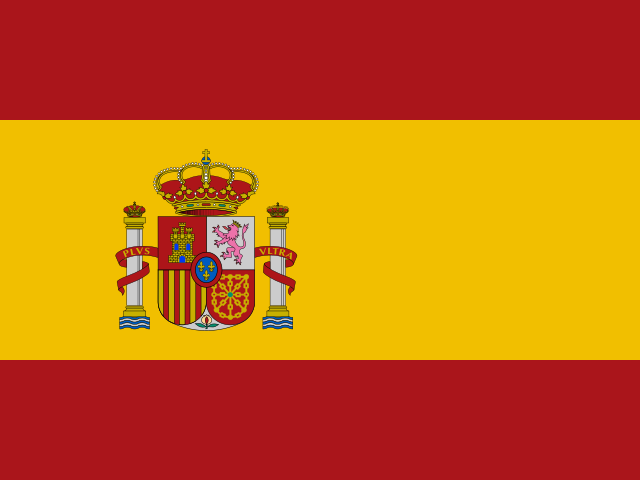
Flag of Spain
The coat of arms combines symbols of Spain’s historic kingdoms, including Castile’s castle and León’s lion.
The broad yellow band is the clue. Its shield sits nearer the left instead of dead centre, with red bands framing it.
Languages and local life
Where the name comes from Derivation of the name "Espana" is uncertain, but may come from the Phoenician term "span," related to the word "spy," meaning "to forge metals," so, "i-spn-ya" would mean "place where metals are forged"; the ancient Phoenicians long exploited the Iberian Peninsula for its mineral wealth.
Language profile Castilian Spanish (official) 74%, Catalan (official in Catalonia, the Balearic Islands, and the Valencian Community) 17%, Galician (official in Galicia) 7%, Basque (official in the Basque Country and Navarre) 2%, Aranese (official in part of Catalonia) <5,000 speakers.
Currency Euro (EUR).
Borders and landscape
Area and borders Total area is about 505,992 km².
Landscape Large, flat to dissected plateau surrounded by rugged hills; Pyrenees Mountains in north.
From high to low Highest point: Pico de Teide (Tenerife) on Canary Islands 3,718 m. Lowest point: Atlantic Ocean 0 m.
A moment in its history
The event Spain’s current Constitution was approved in a constitutional referendum in 1978.
The wider story Its enactment represented the culmination of the Spanish transition to democracy after Francisco Franco’s rule.
From vote to law After approval in a referendum, King Juan Carlos I sanctioned the constitution on 27 December 1978. It took effect two days later.
A person connected to this country
What they contributed “for a rich and intensive prose, which with restrained compassion forms a challenging vision of man's vulnerability”
The person Camilo José Cela, born in Iria Flavia, received the 1989 Nobel Prize in Literature.
Where it is
On the map Spain covers much of Iberia and extends offshore to the Balearics in the western Mediterranean.
Where people live With the notable exception of Madrid, Sevilla, and Zaragoza, the largest urban agglomerations are found along the Mediterranean and Atlantic coasts; numerous smaller cities are spread throughout the interior reflecting Spain's agrarian heritage; very dense settlement around the capital of Madrid, as well as the port city of Barcelona.