
Tunisia
Tunisia sits on the southern side of the central Mediterranean, with the Cap Bon Peninsula pointing northeast toward Sicily.
- Capital
- Tunis
- Region
- Northern Africa
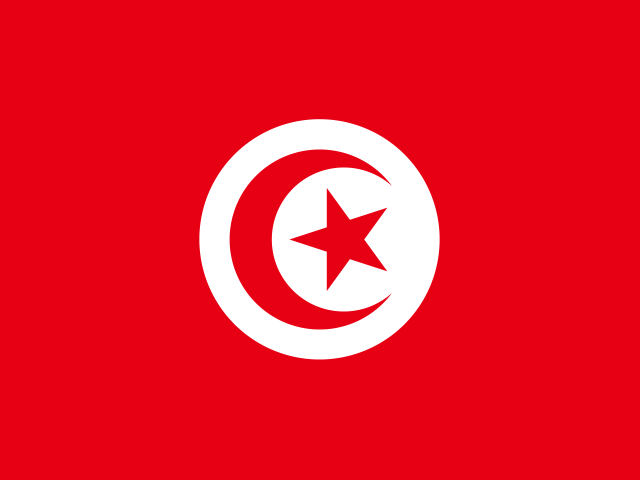
Flag of Tunisia
The crescent and star recall Tunisia’s ties to the Ottoman Empire. The white circle around the symbols is a distinctive part of the Tunisian design.
The crescent and star are red inside a white disc. Türkiye uses white symbols directly on red, with no disc.
Languages and local life
Where the name comes from The country name derives from the capital city of Tunis.
Language profile Arabic (official, one of the languages of commerce), French (commerce), Tamazight.
Currency Tunisian dinar (TND).
Food traditions
The tradition Date palms provide food, but their value extends beyond the fruit. Communities use the fronds for weaving and pass down knowledge of pollination, harvesting and other work that keeps the groves productive.
Culture in the oasis The palm thrives where water is available for irrigation. Alongside its role in crafts and food, the tree is remembered in poetry and song.
Borders and landscape
Area and borders Total area is about 163,610 km². It shares land borders with Algeria and Libya.
Landscape Mountains in north; hot, dry central plain; semiarid south merges into the Sahara.
From high to low Highest point: Jebel ech Chambi 1,544 m. Lowest point: Shatt al Gharsah -17 m.
A person connected to this country
What they contributed “for experimental methods that generate attosecond pulses of light for the study of electron dynamics in matter”
The person Pierre Agostini, born in Tunis, received the 2023 Nobel Prize in Physics.
Where they worked The Ohio State University at the time of the award.
Where it is
On the map Tunisia sits on the southern side of the central Mediterranean, with the Cap Bon Peninsula pointing northeast toward Sicily.
Where people live The overwhelming majority of the population is located in the northern half of the country; the south remains largely underpopulated.