
Uganda
Uganda sits north of Lake Victoria and contains the outlet where the river starts flowing from the lake.
- Capital
- Kampala
- Region
- Eastern Africa
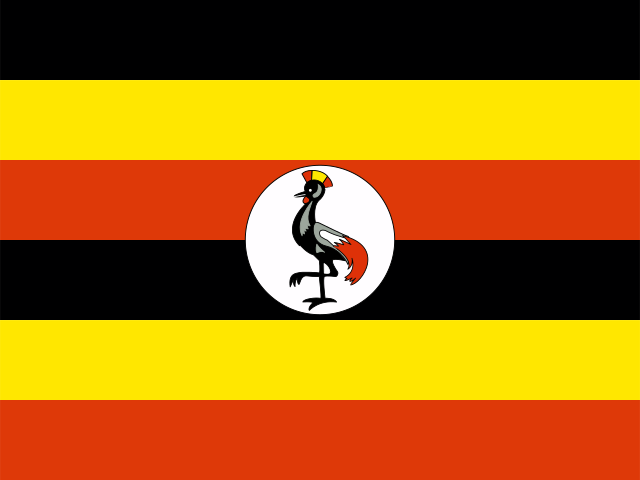
Flag of Uganda
Black symbolizes the African people, yellow sunshine and vitality, red African brotherhood.
Find the crested crane standing in the white disc. The stripes behind it repeat black, yellow and red twice.
Languages and local life
Where the name comes from From the name "Buganda," adopted by the British as the designation for their East African colony in 1894; Buganda had been a powerful East African state during the 18th and 19th centuries.
Language profile English (official), Ganda or Luganda (most widely used of the Niger-Congo languages and the language used most often in the capital), other Niger-Congo languages, Nilo-Saharan languages, Swahili (official), Arabic.
Currency Ugandan shilling (UGX).
Borders and landscape
Area and borders Total area is about 241,550 km². It shares land borders with DR Congo, Kenya, Rwanda, South Sudan and Tanzania.
Landscape Mostly plateau with rim of mountains.
From high to low Highest point: Margherita Peak on Mount Stanley 5,110 m. Lowest point: Albert Nile 614 m.
Where it is
On the map Uganda sits north of Lake Victoria and contains the outlet where the river starts flowing from the lake.
Where people live Population density is relatively high in comparison to other African nations; most of the population is concentrated in the central and southern parts of the country, particularly along the shores of Lake Victoria and Lake Albert; the northeast is least populated.
A person connected to this country
Profile Awon'go Idi Amin Dada Oumee (30 May 1928 – 16 August 2003) was a Ugandan military officer and dictator who served as the third president of Uganda from 1971 until his overthrow in 1979. He gained power after the 1971 Ugandan coup d'état and subsequently ruled the country under a regime characterized by rampant human rights abuses, economic mismanagement and corruption.
From the biography “International observers and human rights groups estimate that between 100,000 and 500,000 people were killed under his regime.”