
Ukraine
Ukraine spans plains drained by the Dnipro and mountainous terrain in the west.
- Capital
- Kyiv
- Region
- Eastern Europe
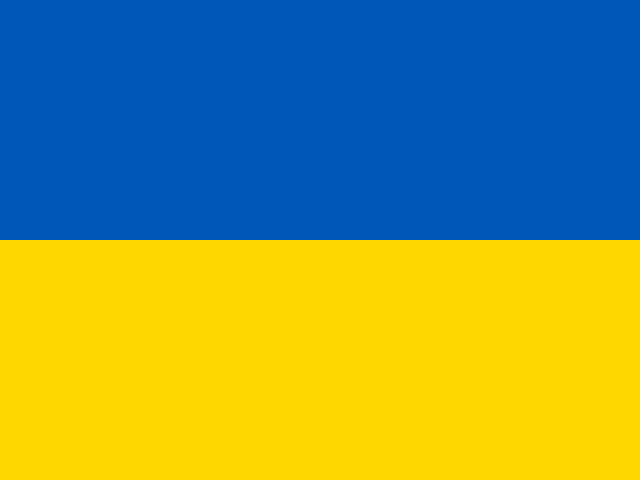
Flag of Ukraine
The blue and yellow are commonly associated with the sky above golden fields of grain.
Only two bands: blue above yellow. Kazakhstan also pairs those colours, but makes yellow a sun and eagle on blue.
Languages and local life
Where the name comes from Name derives from the Old East Slavic word "ukraina" meaning "borderland or march (militarized border region)" and began to be used extensively in the 19th century; originally Ukrainians referred to themselves as Rusyny (Rusyns, Ruthenians, or Ruthenes), an endonym derived from the medieval Rus state (Kyivan Rus).
Language profile Ukrainian (official) 67.5%, Russian (regional language) 29.6%, other (includes Crimean Tatar, Moldovan/Romanian, and Hungarian) 2.9% (2001 est.).
Currency Ukrainian hryvnia (UAH).
Borders and landscape
Area and borders Total area is about 603,500 km². It shares land borders with Belarus, Hungary, Moldova, Poland, Romania, Russia and Slovakia.
Landscape Mostly fertile plains (steppes) and plateaus, with mountains found only in the west (the Carpathians) or in the extreme south of the Crimean Peninsula.
From high to low Highest point: Hora Hoverla 2,061 m. Lowest point: Black Sea 0 m.
A person connected to this country
What they contributed “for her polyphonic writings, a monument to suffering and courage in our time”
The person Svetlana Alexievich, born in Ivano-Frankivsk, received the 2015 Nobel Prize in Literature.
Where it is
On the map Ukraine spans plains drained by the Dnipro and mountainous terrain in the west.
Where people live Densest settlement in the eastern (Donbas) and western regions; noteable concentrations in and around major urban areas of Kyiv, Kharkiv, Donets'k, Dnipropetrovs'k, and Odesa.