
United States
The United States spans these two mountain systems in its contiguous territory and also includes Alaska and Hawaii.
- Capital
- Washington D.C.
- Region
- North America
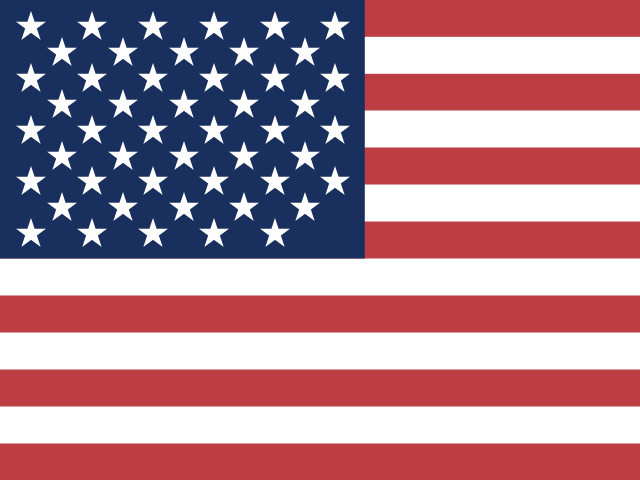
Flag of United States
The 13 stripes represent the original colonies, and the 50 stars represent the states.
The giveaway is the grid of many white stars in the blue corner. Liberia has one there and Malaysia uses a crescent.
Languages and local life
Where the name comes from The name America is derived from that of Amerigo VESPUCCI (1454-1512) - Italian explorer, navigator, and cartographer - using the Latin form of his name, Americus, feminized to America.
Language profile English only 78.2%, Spanish 13.4%, Chinese 1.1%, other 7.3% (2017 est.).
Currency United States dollar (USD).
Borders and landscape
Area and borders Total area is about 9,372,610 km². It shares land borders with Canada and Mexico.
Landscape Vast central plain, mountains in west, hills and low mountains in east; rugged mountains and broad river valleys in Alaska; rugged, volcanic topography in Hawaii.
From high to low Highest point: Denali 6,190 m (Mount McKinley) (highest point in North America). Lowest point: Death Valley (lowest point in North America) -86 m.
A moment in its history
The event The Second Continental Congress adopted the United States Declaration of Independence on 4 July 1776.
The wider story The Revolutionary War had begun in April 1775, before Congress adopted the Declaration in July 1776. The document explained the colonies’ position during an existing conflict; it did not begin and finish the struggle on one day.
The room where it happened Congress adopted the declaration at the Pennsylvania State House in Philadelphia. The building later became known as Independence Hall.
A person connected to this country
What they contributed “for their discoveries concerning light-gated ion channels and optogenetics”
The person Karl Deisseroth, born in Boston, MA, received the 2026 Nobel Prize in Physiology or Medicine.
Where they worked Howard Hughes Medical Institute and Stanford University at the time of the award.
Where it is
On the map The United States spans these two mountain systems in its contiguous territory and also includes Alaska and Hawaii.
Where people live Large urban clusters are spread throughout the eastern half of the US (particularly the Great Lakes area, northeast, east, and southeast) and the western tier states; mountainous areas, principally the Rocky Mountains and Appalachian chain, deserts in the southwest, the dense boreal forests in the extreme north, and the central prarie states are less densely populated; Alaska's population is concentrated along its southern coast - with particular emphasis on the city of Anchorage - and Hawaii's is centered on the island of Oahu.