
Flag of Japan
Japan’s national flag places a deep red sun at the centre of a white field. It is officially called Nisshōki and commonly known as the Hinomaru.
- Height to width
- 2:3
- Flag defined by law
- 1999
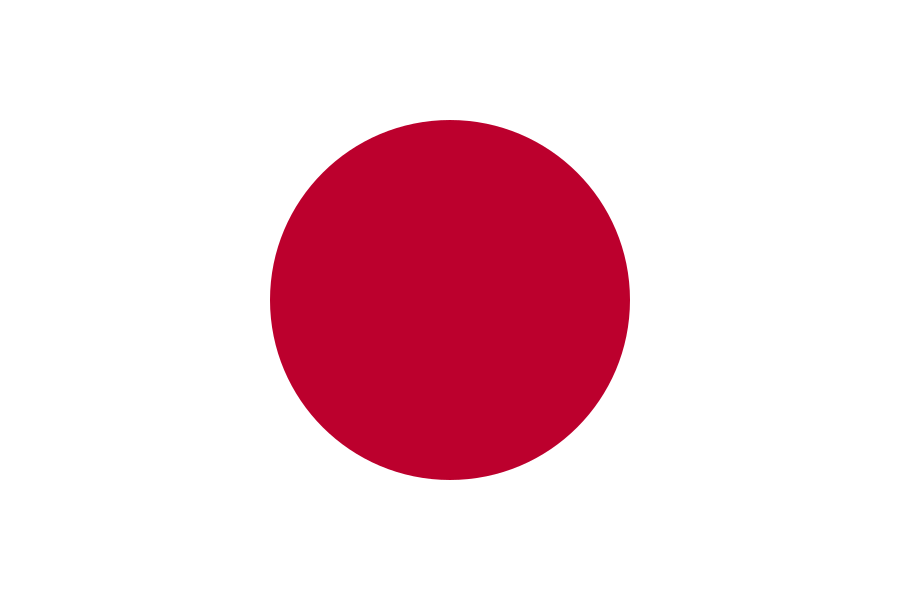
A sun defined by its size and position
The national flag has only two elements, so small choices about scale and position have a large effect. Japan’s Cabinet Office specifies a height-to-width ratio of two to three. The disc is centred both vertically and horizontally, and its diameter measures three-fifths of the flag’s height. If the flag is 60 centimetres high, it is 90 centimetres wide and the disc is 36 centimetres across. That leaves 12 centimetres of white above the disc and another 12 beneath it.
The Cabinet Office describes the field as white and the disc as deep red. The margins are useful when you see a tiny icon or a flag partly folded over its pole. Imagine the full rectangle before judging the disc’s position. A crease can make a centred disc appear to shift, while the design on a flat flag has equal space on opposite sides.
Hinomaru, Nisshōki and the 1999 law
The two names describe the same flag. Hinomaru refers to the sun’s circle, while Nisshōki is the official name used for the sun flag. The image fits a familiar description of Japan as the land of the rising sun. The design presents that idea with a simple disc, leaving the rest of the cloth white.
The 1999 Law Regarding the National Flag and National Anthem formalised both this design and the anthem, Kimi ga Yo. The date tells you when the national symbol was defined in that law. The Hinomaru itself was in use well before then. When reading about Japanese flags, the English description “rising sun” can also refer to designs with red rays spreading across the field. Look for the rays in the image or for the Japanese name in the caption. The national flag shown here uses a plain disc.
Japan, Bangladesh and Palau
-
JapanCentred red sun on white 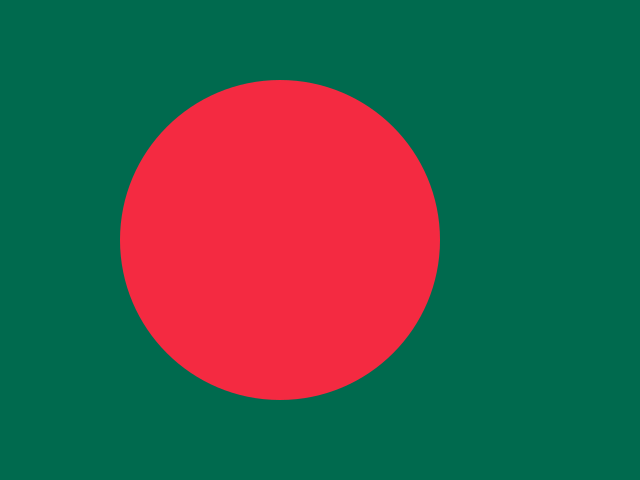
BangladeshRed disc on green 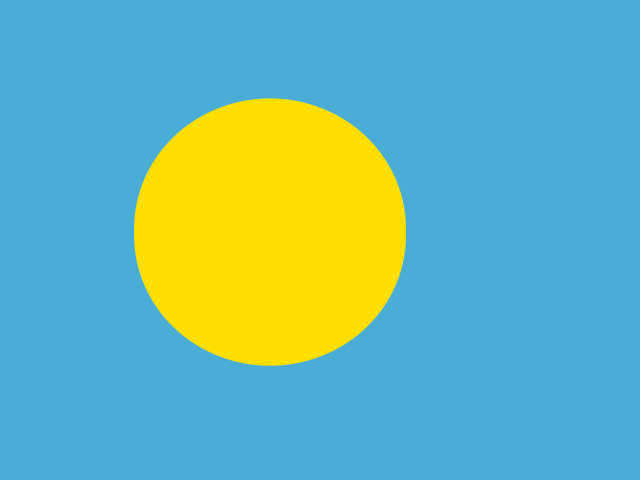
PalauGold moon on blue
Bangladesh pairs a red disc with a dark green field. The disc sits closer to the hoist, or pole side, than to the free edge. Japan gives its red disc equal space on both sides and uses a white field. If the flags are so small that judging the offset is difficult, use the white or green ground first.
Palau also uses a single disc shifted toward the pole. Its disc is yellow on light blue and represents the moon. This is a useful reminder that a circle alone can represent different objects. Compare the field, the disc colour and the position in that order. To remember Japan’s combination, picture a red circle on clean white with the same margin above and below. The lack of text, rays or other symbols is part of the design.