
Flag of South Africa
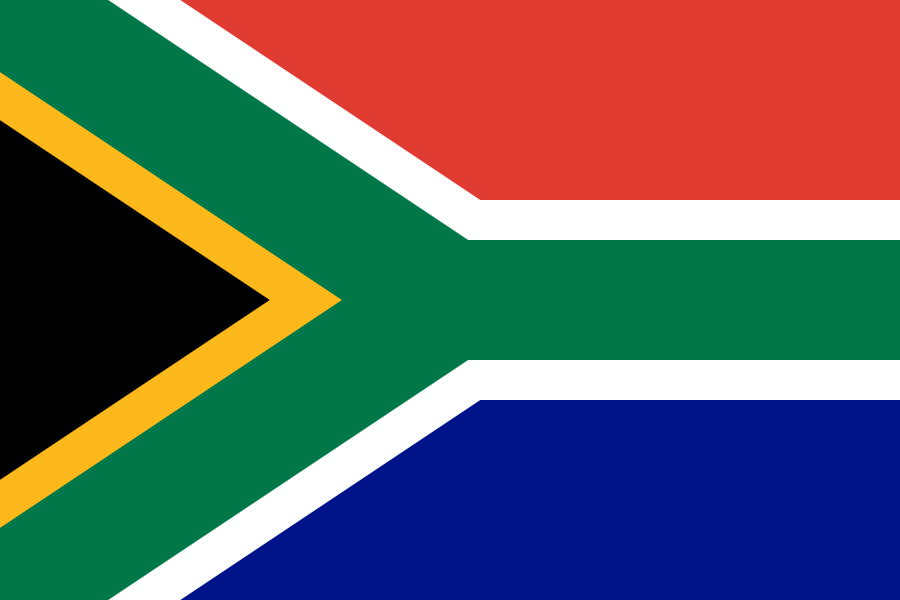
On South Africa’s national flag, two arms of green meet near the middle and continue as one band. The design was first used on 27 April 1994, at the transition to a new democracy.
- Height to width
- 2:3
- Flag first used
- 1994
Follow the green bands from the pole
Start at the hoist and follow the two branches of green toward the middle. They join and carry on as one horizontal band all the way to the free edge. Above that green band is a red area and below it is blue, both separated from green by white edging. At the pole side, a black triangle sits between the green branches and has gold edging. This is why the silhouette stays recognisable even when some of the colours disappear into a fold.
The government describes the joining bands as a possible image of different parts of South African society coming together and moving forward in unity. It also cautions against attaching a single universal meaning to each individual colour. People can connect the colours with different strands of the country’s flag history. The point where the green branches meet is a better place to start when explaining what makes the design distinctive.
Why 27 April 1994 matters
Fred Brownell, South Africa’s State Herald, designed the flag used at the time of the country’s first democratic elections with universal adult suffrage. Its first use on 27 April 1994 linked it immediately with a change in who could participate in choosing the government. The date is now celebrated as Freedom Day. The flag was introduced for the transition and became the lasting national flag.
The flag also has a definite orientation, even when it hangs without a pole. Displayed horizontally with the hoist at the left, red belongs on top. The South African government also gives a rule for wall display: when the hoist is at the top, the red should be on the viewer’s left. The red and blue areas are a quick way to check whether an image shows the flag in the intended orientation.
South Africa, Zimbabwe and Mozambique
-
South AfricaGreen branches form a Y 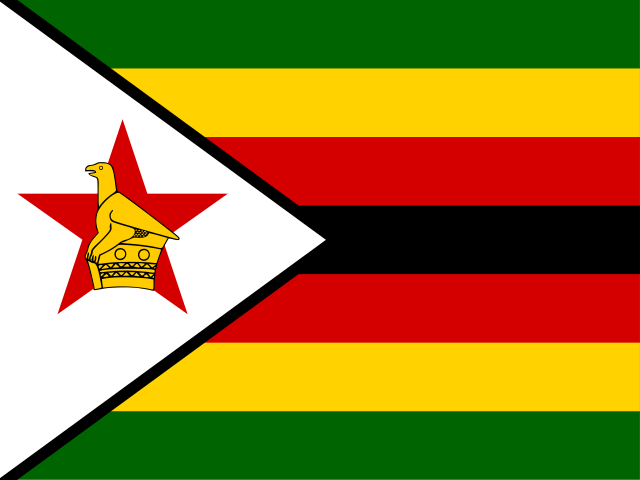
ZimbabweWhite triangle with bird 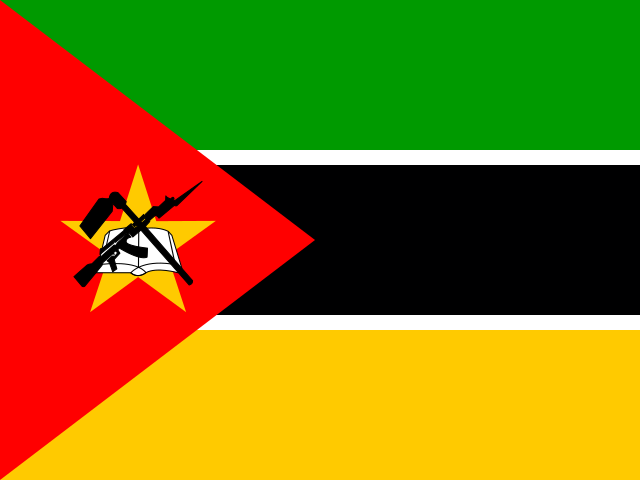
MozambiqueRed triangle with emblem
Zimbabwe uses several of the same colours and has a triangle at the pole. Its triangle is white and contains the Zimbabwe Bird and a red star. The rest of the design uses a series of horizontal stripes. Look for the forks of green that merge near the middle of South Africa’s flag. Zimbabwe’s stripes run straight.
Mozambique also has green, black and yellow with white divisions, plus a red triangle at the pole containing an emblem. Its stripes again run straight. If an answer image is tiny, look at the boundary between the triangle and the rest of the flag. On South Africa’s design, that boundary continues into a green band on the other side. The connection is more reliable than counting colours.