
Argentina
Argentina stretches from the Andes along its western border across broad plains to the Atlantic and the Río de la Plata. Its mountain edge includes Aconcagua, which rises to 6,962 metres and is the highest summit outside Asia.
- Capital
- Buenos Aires
- Region
- South America
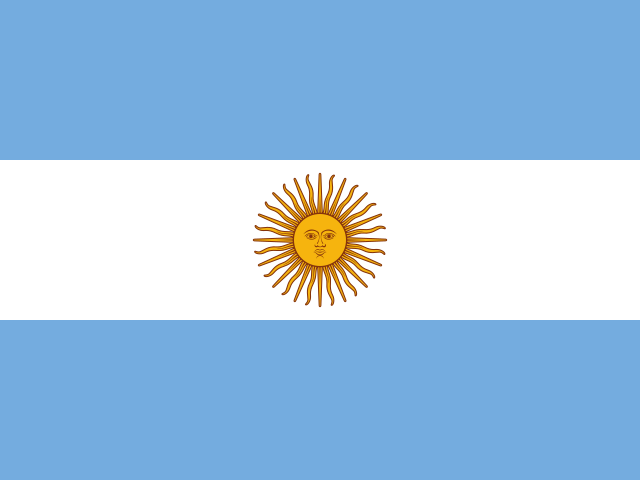
Flag of Argentina
The Sun of May recalls the May Revolution of 1810 and the move toward independence.
Argentina puts the sun in the middle. Uruguay moves it into the upper-left corner and adds more stripes.
Compare with Uruguay.
Languages and local life
Where the name comes from Originally the area was referred to as Tierra Argentina, i.e., "Land beside the Silvery River" or "silvery land," which referred to the massive estuary in the east of the country, the Río de la Plata (River of Silver); over time the name shortened to simply Argentina or "silvery".
Language profile Spanish (official), Italian, English, German, French, indigenous (Quechua, Guarani, Mapudungun).
Currency Argentine peso (ARS).
Borders and landscape
Area and borders Total area is about 2,780,400 km². It shares land borders with Bolivia, Brazil, Chile, Paraguay and Uruguay.
Landscape Rich plains of the Pampas in northern half, flat to rolling plateau of Patagonia in south, rugged Andes along western border.
From high to low Highest point: Cerro Aconcagua (located in the northwestern corner of the province of Mendoza; highest point in South America) 6,962 m. Lowest point: Laguna del Carbón (located between Puerto San Julián and Comandante Luis Piedra Buena in the province of Santa Cruz) -105 m.
A moment in its history
The event The Congress of Tucumán declared independence on 9 July 1816.
The wider story Several provinces of Upper Peru, later part of Bolivia, were represented at the congress, while the Federal League provinces were excluded. The gathering’s political geography does not map neatly onto present-day national borders.
Who came to Tucumán Delegates from parts of Upper Peru, which later became part of Bolivia, attended the congress.
A person connected to this country
What they contributed “for theories concerning the specificity in development and control of the immune system and the discovery of the principle for production of monoclonal antibodies”
The person César Milstein, born in Bahia Blanca, received the 1984 Nobel Prize in Physiology or Medicine.
Where they worked MRC Laboratory of Molecular Biology at the time of the award.
Where it is
On the map Argentina stretches from the Andes along its western border across broad plains to the Atlantic and the Río de la Plata. Its mountain edge includes Aconcagua, which rises to 6,962 metres and is the highest summit outside Asia.
Where people live One-third of the population lives in Buenos Aires; pockets of agglomeration occur throughout the northern and central parts of the country; Patagonia to the south remains sparsely populated.