
Uruguay
Uruguay lies on the northern bank of the Río de la Plata opposite Argentina, with Brazil along its northern edge.
- Capital
- Montevideo
- Region
- South America
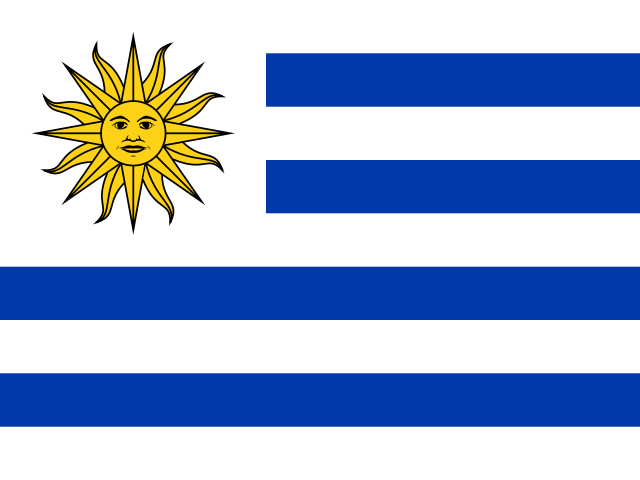
Flag of Uruguay
The stripes represent the nine original departments of Uruguay.
Uruguay’s sun sits in the upper-left corner. Argentina puts a similar sun in the centre of its simpler three-band design.
Compare with Argentina.
Languages and local life
Where the name comes from Name derives from the Spanish pronunciation of the Guarani Indian designation of the Uruguay River, which makes up the western border of the country and whose name later came to be applied to the entire country.
Language profile Spanish (official, Rioplatense is the most widely spoken dialect).
Currency Uruguayan peso (UYU).
Borders and landscape
Area and borders Total area is about 181,034 km². It shares land borders with Argentina and Brazil.
Landscape Mostly rolling plains and low hills; fertile coastal lowland.
From high to low Highest point: Cerro Catedral 514 m. Lowest point: Atlantic Ocean 0 m.
Where it is
On the map Uruguay lies on the northern bank of the Río de la Plata opposite Argentina, with Brazil along its northern edge.
Where people live Most of the country's population resides in the southern half of the country; approximately 80% of the populace is urban, living in towns or cities; nearly half of the population lives in and around the capital of Montevideo.
A person connected to this country
Profile José Alberto "Pepe" Mujica Cordano (20 May 1935 – 13 May 2025) was a Uruguayan politician, revolutionary and farmer who served as the 40th president of Uruguay from 2010 to 2015. A former guerrilla with the Tupamaros, he was tortured and imprisoned for 14 years during the military dictatorship in the 1970s and 1980s.
From the biography “As the candidate of the Broad Front, he won the 2009 presidential election and took office as president on 1 March 2010.”