
Costa Rica
Costa Rica crosses the Central American isthmus between Nicaragua and Panama, with sea on both sides.
- Capital
- San José
- Region
- Central America
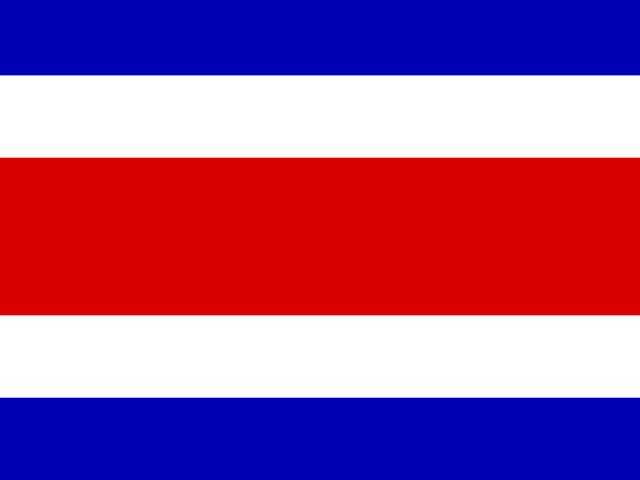
Flag of Costa Rica
The wide red stripe was added in 1848, when Costa Rica adapted the blue-and-white Central American design using France’s colours.
Compare the middle stripes. Costa Rica widens the red one. Thailand widens the blue one.
Compare with Thailand · North Korea.
Languages and local life
Where the name comes from The name means "rich coast" in Spanish and was first applied in the early colonial period of the 16th century.
Language profile Spanish (official), English.
Currency Costa Rican colón (CRC).
Borders and landscape
Area and borders Total area is about 51,100 km². It shares land borders with Nicaragua and Panama.
Landscape Coastal plains separated by rugged mountains including over 100 volcanic cones, of which several are major active volcanoes.
From high to low Highest point: Cerro Chirripo 3,819 m. Lowest point: Pacific Ocean 0 m.
A person connected to this country
What they contributed “for his work for lasting peace in Central America”
The person Oscar Arias Sánchez, born in Heredia, received the 1987 Nobel Prize in Peace.
Where it is
On the map Costa Rica crosses the Central American isthmus between Nicaragua and Panama, with sea on both sides.
Where people live Roughly half of the nation's population resides in urban areas; the capital of San Jose is the largest city and home to approximately one-fifth of the population.