
North Korea
North Korea holds the peninsula's northern territory and reaches the Yalu on its northwestern frontier.
- Capital
- Pyongyang
- Region
- Eastern Asia
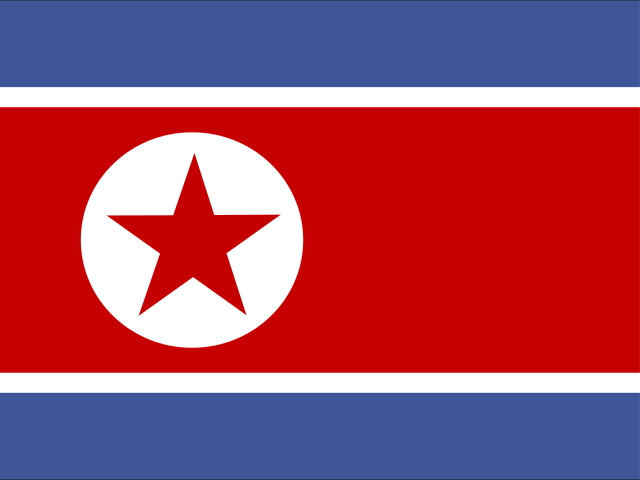
Flag of North Korea
The broad red band symbolizes revolutionary traditions.
The red star is inside a white circle to the left. Laos puts a plain white circle in the middle of a blue band.
Compare with Thailand · Costa Rica.
Languages and local life
Where the name comes from Derived from the Chinese name for Goryeo, which was the Korean dynasty that united the peninsula in the 10th century A.D.; the North Korean name "Choson" means "[Land of the] Morning Calm".
Language profile Korean.
Currency North Korean won (KPW).
Food traditions
The tradition During kimjang, families and neighbours prepare large batches of kimchi for winter. Recipes vary by household and region, and sharing the work helps pass them on.
Why recipes vary Families adapt ingredients and methods to local climates and household preferences. The seasoned vegetables develop their flavour through lactic fermentation.
Borders and landscape
Area and borders Total area is about 120,538 km². It shares land borders with China, South Korea and Russia.
Landscape Mostly hills and mountains separated by deep, narrow valleys; wide coastal plains in west, discontinuous in east.
From high to low Highest point: Paektu-san 2,744 m. Lowest point: Sea of Japan 0 m.
Where it is
On the map North Korea holds the peninsula's northern territory and reaches the Yalu on its northwestern frontier.
Where people live Population concentrated in the plains and lowlands; least populated regions are the mountainous provinces adjacent to the Chinese border; largest concentrations are in the western provinces, particularly the municipal district of Pyongyang, and around Hungnam and Wonsan in the east.