
Ecuador
Ecuador straddles the equator on the South American mainland and also includes the far-off Galápagos archipelago.
- Capital
- Quito
- Region
- South America
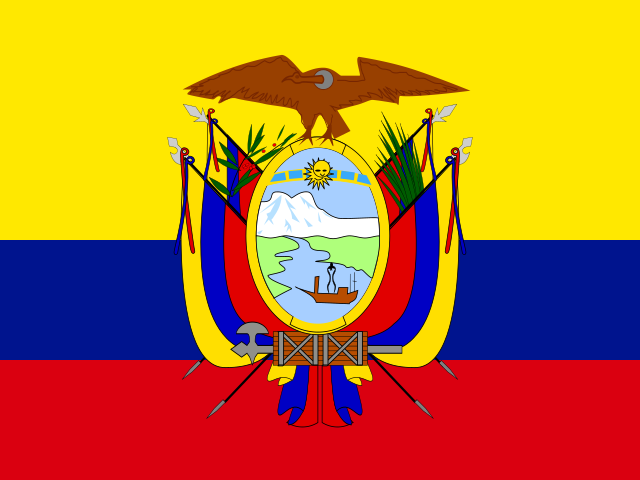
Flag of Ecuador
The yellow color represents sunshine, grain, and mineral wealth, blue the sky, sea, and rivers, and red the blood of patriots spilled in the struggle for freedom and justice.
Look for Colombia’s wide yellow top with a coat of arms added. Venezuela gives itself away with a row of stars.
Languages and local life
Where the name comes from The country's position on the globe, straddling the Equator, accounts for its Spanish name.
Language profile Spanish (Castilian; official) 98.6%, indigenous 3.9% (Quechua 3.2%, other indigenous 0.7%), foreign 2.8%, other 0.6% (includes Ecuadorian sign language) (2022 est.).
Currency United States dollar (USD).
Borders and landscape
Area and borders Total area is about 276,841 km². It shares land borders with Colombia and Peru.
Landscape Coastal plain (costa), inter-Andean central highlands (sierra), and flat to rolling eastern jungle (oriente).
From high to low Highest point: Chimborazo 6,267. Lowest point: Pacific Ocean 0 m.
Where it is
On the map Ecuador straddles the equator on the South American mainland and also includes the far-off Galápagos archipelago.
Where people live Nearly half of the population is concentrated in the interior in the Andean intermontane basins and valleys, with large concentrations also found along the western coastal strip; the rainforests of the east remain sparsely populated.
A person connected to this country
Profile Oswaldo Guayasamín Calero (July 6, 1919 – March 10, 1999) was an Ecuadorian painter and sculptor of Kichwa and Mestizo heritage.
A gallery for human experience Guayasamín worked on large public murals as well as paintings. His foundation in Quito preserves his work and the Capilla del Hombre, the cultural space he set out to build.