
Venezuela
Venezuela spans the Orinoco basin and the Llanos south of a long Caribbean coast.
- Capital
- Caracas
- Region
- South America
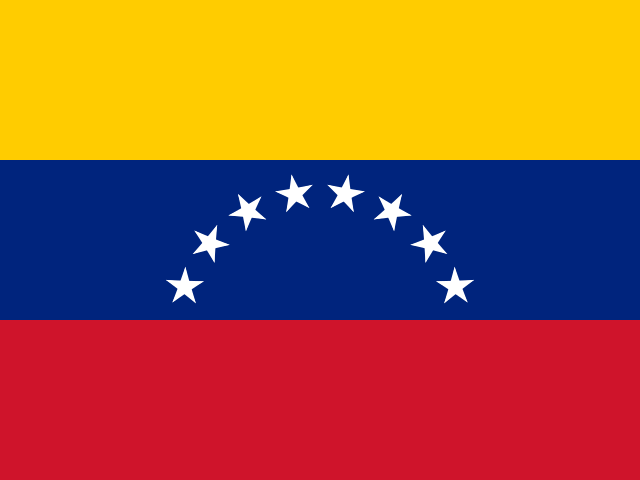
Flag of Venezuela
The yellow, blue and red come from Gran Colombia’s flag. The original seven stars represented provinces that united for independence.
Look for the arc of white stars across blue. Colombia has no emblem and Ecuador has a coat of arms in the middle.
Languages and local life
Where the name comes from Native stilt-houses built on Lake Maracaibo reminded early explorers Alonso de OJEDA and Amerigo VESPUCCI in 1499 of buildings in Venice and so they named the region "Venezuola," which in Italian means "Little Venice".
Language profile Spanish (official) 98.2%, indigenous 1.3%, Portuguese 0.1%, other 0.4% (2023 est.).
Currency Venezuelan bolívar soberano (VES).
Borders and landscape
Area and borders Total area is about 916,445 km². It shares land borders with Brazil, Colombia and Guyana.
Landscape Andes Mountains and Maracaibo Lowlands in northwest; central plains (llanos); Guiana Highlands in southeast.
From high to low Highest point: Pico Bolivar 4,978 m. Lowest point: Caribbean Sea 0 m.
A person connected to this country
What they contributed “for their discoveries concerning genetically determined structures on the cell surface that regulate immunological reactions”
The person Baruj Benacerraf, born in Caracas, received the 1980 Nobel Prize in Physiology or Medicine.
Where they worked Harvard Medical School at the time of the award.
Where it is
On the map Venezuela spans the Orinoco basin and the Llanos south of a long Caribbean coast.
Where people live Most of the population is concentrated in the northern and western highlands along an eastern spur at the northern end of the Andes, an area that includes the capital of Caracas.