
Kuwait
Kuwait occupies the small coastal area between Iraq and Saudi Arabia at the head of the gulf.
- Capital
- Kuwait City
- Region
- Western Asia
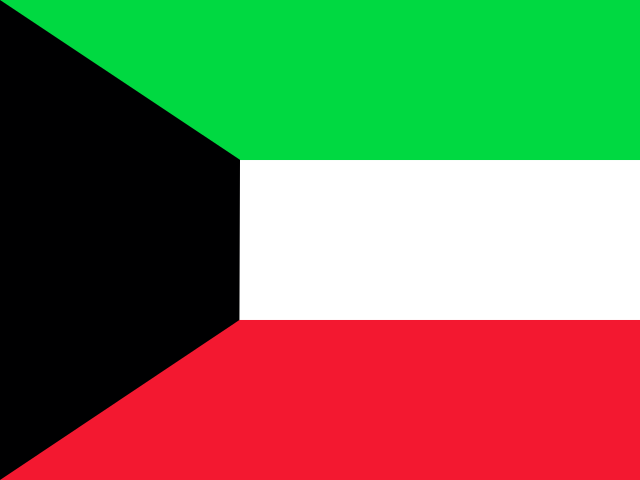
Flag of Kuwait
Green represents fertile fields, white stands for purity, red denotes blood on Kuwaiti swords, black signifies the defeat of the enemy.
The black shape at the left has a flat end, not a point. Sudan uses a green triangle and puts black at the bottom.
Compare with Palestine · Jordan · Sudan · United Arab Emirates.
Languages and local life
Where the name comes from The name derives from the capital city, which is from Arabic "al-Kuwayt" a diminutive of "kut" meaning "fortress," possibly a reference to a small castle built on the current location of Kuwait City by the Beni Khaled tribe in the 17th century.
Language profile Arabic (official), English widely spoken.
Currency Kuwaiti dinar (KWD).
Food traditions
The tradition Date palms provide food, but their value extends beyond the fruit. Communities use the fronds for weaving and pass down knowledge of pollination, harvesting and other work that keeps the groves productive.
Culture in the oasis The palm thrives where water is available for irrigation. Alongside its role in crafts and food, the tree is remembered in poetry and song.
Borders and landscape
Area and borders Total area is about 17,818 km². It shares land borders with Iraq and Saudi Arabia.
Landscape Flat to slightly undulating desert plain.
From high to low Highest point: 3.6 km W. of Al-Salmi Border Post 300 m. Lowest point: Persian Gulf 0 m.
Where it is
On the map Kuwait occupies the small coastal area between Iraq and Saudi Arabia at the head of the gulf.
Where people live Densest settlement is along the Persian Gulf, particularly in Kuwait City and on Bubiyan Island; significant population threads extend south and west along highways that radiate from the capital, particularly in the southern half of the country.