
United Arab Emirates
The United Arab Emirates includes several emirates along the Persian Gulf and Fujairah across the mountains on the Gulf of Oman.
- Capital
- Abu Dhabi
- Region
- Western Asia
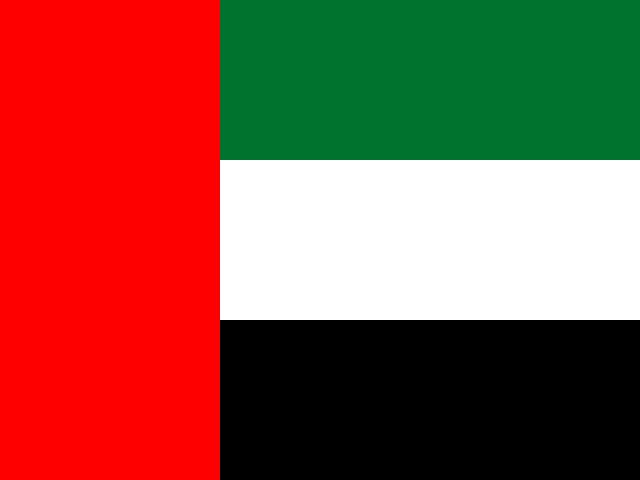
Flag of United Arab Emirates
The flag incorporates all four Pan-Arab colors, which in this case represent fertility (green), neutrality (white), petroleum resources (black), and unity (red).
Remember the red bar standing upright at the left. Kuwait puts a black wedge there instead.
Languages and local life
Where the name comes from Self-descriptive country name; the name "Arabia" can be traced back many centuries B.C., the ancient Egyptians referred to the region as "Ar Rabi"; "emirates" derives from "amir" the Arabic word for "commander," "lord," or "prince".
Language profile Arabic (official), English, Hindi, Malayalam, Urdu, Pashto, Tagalog, Persian.
Currency United Arab Emirates dirham (AED).
Food traditions
The tradition Date palms provide food, but their value extends beyond the fruit. Communities use the fronds for weaving and pass down knowledge of pollination, harvesting and other work that keeps the groves productive.
Culture in the oasis The palm thrives where water is available for irrigation. Alongside its role in crafts and food, the tree is remembered in poetry and song.
Borders and landscape
Area and borders Total area is about 83,600 km². It shares land borders with Oman and Saudi Arabia.
Landscape Flat, barren coastal plain merging into rolling sand dunes of vast desert; mountains in east.
From high to low Highest point: Jabal Bil 'Ays 1,905 m. Lowest point: Persian Gulf 0 m.
Where it is
On the map The United Arab Emirates includes several emirates along the Persian Gulf and Fujairah across the mountains on the Gulf of Oman.
Where people live Population is heavily concentrated to the northeast on the Musandam Peninsula; the three largest emirates - Abu Dhabi, Dubai, and Sharjah - are home to nearly 85% of the population.