
Laos
Laos is the only landlocked country in mainland Southeast Asia, yet water is central to its geography. The Mekong forms long stretches of its boundary with Thailand, and the capital sits beside the river opposite Thai territory. A country without a coastline can still be defined by a major waterway; here the river acts as a connection and a border.
- Capital
- Vientiane
- Region
- South-Eastern Asia
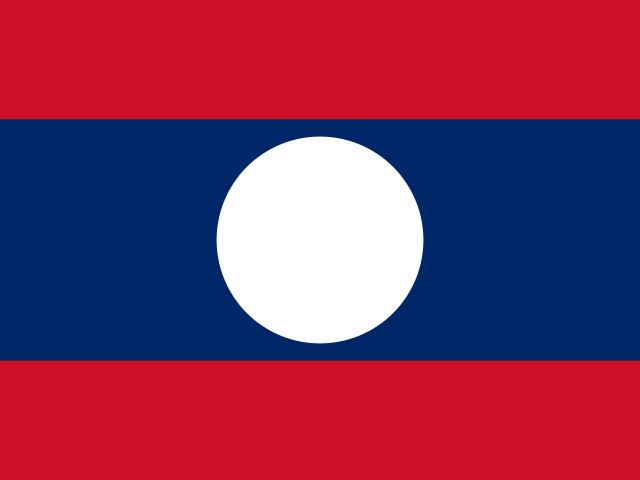
Flag of Laos
The white disc represents the full moon over the Mekong River. The blue band evokes the river.
A white disc on blue is the centre of Laos’s flag. North Korea puts a red star inside its white circle and moves it left.
Compare with Japan · Bangladesh · Palau · South Korea.
Languages and local life
Where the name comes from Name means "Land of the Lao [people]".
Language profile Lao (official), French, English, various ethnic languages.
Currency Lao kip (LAK).
Borders and landscape
Area and borders Total area is about 236,800 km². It shares land borders with Myanmar, Cambodia, China, Thailand and Vietnam.
Landscape Mostly rugged mountains; some plains and plateaus.
From high to low Highest point: Phu Bia 2,817 m. Lowest point: Mekong River 70 m.
Where it is
On the map Laos is the only landlocked country in mainland Southeast Asia, yet water is central to its geography. The Mekong forms long stretches of its boundary with Thailand, and the capital sits beside the river opposite Thai territory. A country without a coastline can still be defined by a major waterway; here the river acts as a connection and a border.
Where people live Most densely populated area is in and around the capital city of Vientiane; large communities are primarily found along the Mekong River along the southwestern border; overall density is considered one of the lowest in Southeast Asia.
A person connected to this country
Profile Kaysone Phomvihane (Lao: ໄກສອນ ພົມວິຫານ, pronounced [kàj.sɔ̌ːn pʰóm.wī(ʔ).hǎːn]; 13 December 1920 – 21 November 1992) was a Laotian politician and revolutionary who served as the first leader of the Communist Lao People's Revolutionary Party from 1955 until his death in 1992. After the Communists seized power in the wake of the Laotian Civil War, he was the de facto leader of Laos from 1975 until his death.
From the biography “His theories and policies are officially known as Kaysone Phomvihane Thought.”