
Libya
Libya reaches the Mediterranean around the wide Gulf of Sidra and extends deep into the Sahara behind it.
- Capital
- Tripoli
- Region
- Northern Africa
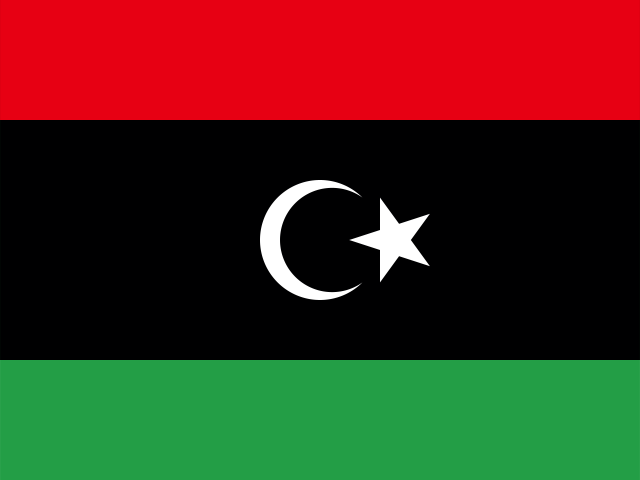
Flag of Libya
The colors represent the three major regions of the country: red stands for Fezzan, black symbolizes Cyrenaica, and green denotes Tripolitania.
Find the crescent on the broad black middle band. Red is above and green below, rather than one solid field.
Compare with Algeria · Pakistan · Mauritania · Azerbaijan · Maldives · Turkmenistan · Uzbekistan.
Languages and local life
Where the name comes from Name derives from the Libu, an ancient Libyan tribe first mentioned in texts from the 13th century B.C.
Language profile Arabic (official), Italian, English (all widely understood in the major cities); Tamazight (Nafusi, Ghadamis, Suknah, Awjilah, Tamasheq).
Currency Libyan dinar (LYD).
Borders and landscape
Area and borders Total area is about 1,759,540 km². It shares land borders with Algeria, Chad, Egypt, Niger, Sudan and Tunisia.
Landscape Mostly barren, flat to undulating plains, plateaus, depressions.
From high to low Highest point: Bikku Bitti 2,267 m. Lowest point: Sabkhat Ghuzayyil -47 m.
Where it is
On the map Libya reaches the Mediterranean around the wide Gulf of Sidra and extends deep into the Sahara behind it.
Where people live Well over 90% of the population lives along the Mediterranean coast in and between Tripoli to the west and Al Bayda to the east; the interior remains vastly underpopulated due to the Sahara and lack of surface water.
A person connected to this country
Profile Muammar Muhammad Abu Minyar al-Gaddafi (c. 1942 – 20 October 2011) was a Libyan military officer, revolutionary, politician, and political theorist who ruled Libya from 1969 until his overthrow by Libyan rebel forces in 2011 during the First Libyan Civil War.
From the biography “Initially ideologically committed to Arab nationalism and Arab socialism, Gaddafi later ruled according to his own Third International Theory.”