
Uzbekistan
Uzbekistan links the Silk Road cities of Samarkand and Bukhara and sits inside an already landlocked part of Central Asia.
- Capital
- Tashkent
- Region
- Central Asia
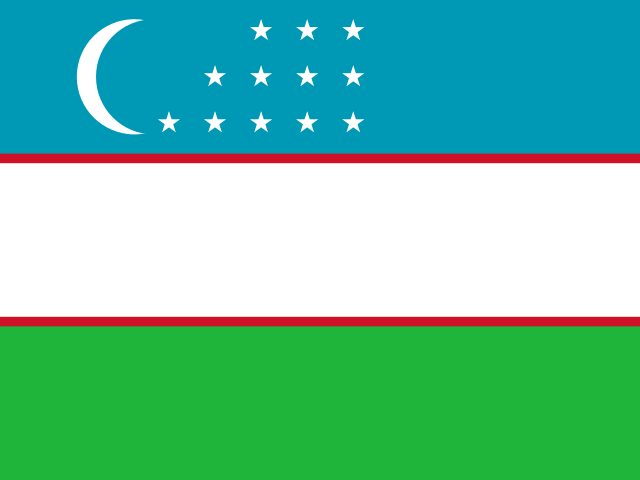
Flag of Uzbekistan
Blue is the color of the Turkic peoples and of the sky, white signifies peace and the striving for purity in thoughts and deeds, while green represents nature and is the color of Islam.
Find a crescent and rows of small stars in the blue stripe, plus the thin red lines between the three broad bands.
Compare with Algeria · Pakistan · Mauritania · Libya · Azerbaijan · Maldives · Turkmenistan.
Languages and local life
Where the name comes from A combination of the Turkic words "uz" (self) and "bek" (master) with the Persian suffix "-stan" (country) to give the meaning "Land of the Free".
Language profile Uzbek (official) 74.3%, Russian 14.2%, Tajik 4.4%, other 7.1%.
Currency Uzbekistani soʻm (UZS).
Borders and landscape
Area and borders Total area is about 447,400 km². It shares land borders with Afghanistan, Kazakhstan, Kyrgyzstan, Tajikistan and Turkmenistan.
Landscape Mostly flat-to-rolling sandy desert with dunes; broad, flat intensely irrigated river valleys along course of Amu Darya, Syr Darya (Sirdaryo), and Zaravshan; Fergana Valley in east surrounded by mountainous Tajikistan and Kyrgyzstan; shrinking Aral Sea in west.
From high to low Highest point: Xazrat Sulton Tog' 4,643 m. Lowest point: Sariqamish Kuli -12 m.
Where it is
On the map Uzbekistan links the Silk Road cities of Samarkand and Bukhara and sits inside an already landlocked part of Central Asia.
Where people live Most of the population is concentrated in the fertile Fergana Valley in the easternmost arm of the country; the south has significant clusters of people, while the central and western deserts are sparsely populated.
A person connected to this country
Profile Timur (1320s – 17/18 February 1405), also known as Tamerlane, was a Turco-Mongol conqueror, first ruler of the Timurid dynasty, and the founder of the Timurid Empire, which ruled over modern-day Afghanistan, Iran, and Central Asia. He was undefeated in most battles and is widely regarded as one of the greatest military leaders and tacticians in history, as well as one of the most brutal and deadly.
From the biography “Timur is also considered a great patron of the arts, for he interacted with scholars and poets such as ibn Khaldun, Hafez, and Hafiz-i Abru.”