
Lithuania
Lithuania is the southernmost Baltic state, with a short shore that includes part of the Curonian Spit.
- Capital
- Vilnius
- Region
- Northern Europe
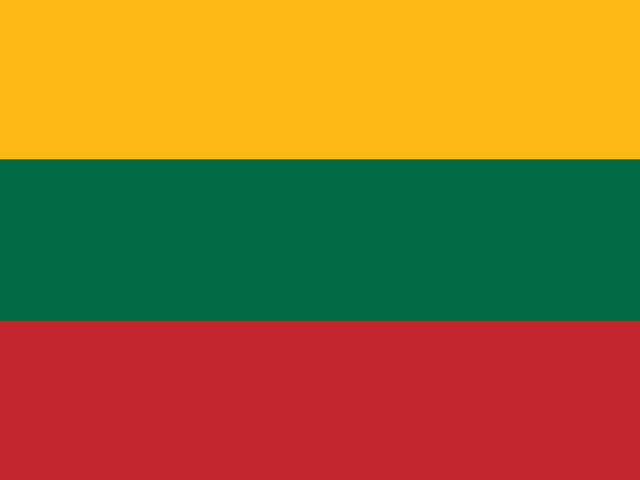
Flag of Lithuania
Yellow symbolizes golden fields, as well as the sun, light, and goodness.
The yellow stripe goes on top. Myanmar uses the same top-to-bottom order but places a large white star over it.
Languages and local life
Where the name comes from Meaning of the name "Lietuva" remains unclear and is debated by scholars; it may derive from the Lietava, a stream in east central Lithuania.
Language profile Lithuanian (official) 85.3%, Russian 6.8%, Polish 5.1%, other 1.1%, two mother tongues 1.7% (2021 est.).
Currency Euro (EUR).
Borders and landscape
Area and borders Total area is about 65,300 km². It shares land borders with Belarus, Latvia, Poland and Russia.
Landscape Lowland, many scattered small lakes, fertile soil.
From high to low Highest point: Aukstojas 294 m. Lowest point: Baltic Sea 0 m.
A person connected to this country
What they contributed “for his development of crystallographic electron microscopy and his structural elucidation of biologically important nucleic acid-protein complexes”
The person Aaron Klug, born in Zelvas, received the 1982 Nobel Prize in Chemistry.
Where they worked MRC Laboratory of Molecular Biology at the time of the award.
Where it is
On the map Lithuania is the southernmost Baltic state, with a short shore that includes part of the Curonian Spit.
Where people live Fairly even population distribution throughout the country, but somewhat greater concentrations in the southern cities of Vilnius and Kaunas, and the western port of Klaipeda.