
Ethiopia
Ethiopia's high plateau contains Lake Tana, the source of the Blue Nile. That river later meets the White Nile at Khartoum in Sudan, so a river strongly associated with Egypt also leads back to other countries. Within Ethiopia, the highland setting contrasts with the hot, low Danakil Depression in the northeast. The river clue and the elevation clue reinforce each other.
- Capital
- Addis Ababa
- Region
- Eastern Africa
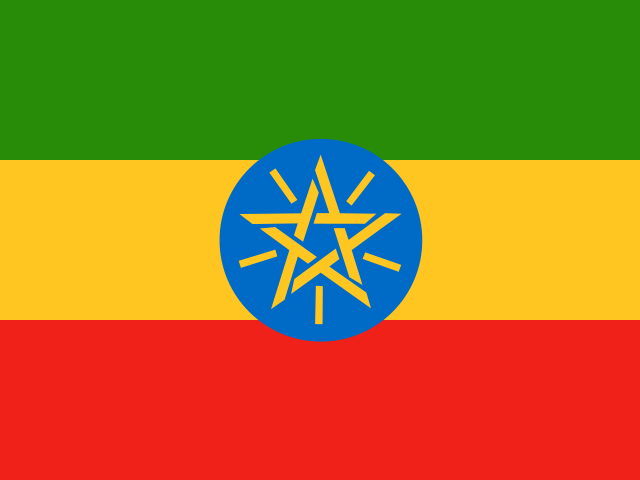
Flag of Ethiopia
Green represents hope and the fertility of the land, yellow symbolizes justice and harmony, while red stands for sacrifice and heroism in the defense of the land.
Pick out the blue disc first. The gold star is inside it, unlike Ghana’s black star sitting directly on yellow.
Compare with Ghana · Bolivia · Burkina Faso · Lithuania · Myanmar.
Languages and local life
Where the name comes from The country name derives from the Greek word "Aethiopia," which in classical times referred to lands south of Egypt in the Upper Nile region.
Language profile Oromo (official regional working language) 33.8%, Amharic (official national language) 29.3%, Somali (official regional working language) 6.2%, Tigrigna (Tigrinya) (official regional working language) 5.9%, Sidamo 4%, Wolaytta 2.2%, Gurage 2%, Afar (official regional working language) 1.7%, Hadiyya 1.7%, Gamo 1.5%, Gedeo 1.3%, Opuuo 1.2%, Kafa 1.1%, other 8.1%, English (2007 est.).
Currency Ethiopian birr (ETB).
Borders and landscape
Area and borders Total area is about 1,104,300 km². It shares land borders with Djibouti, Eritrea, Kenya, Somalia, South Sudan and Sudan.
Landscape High plateau with central mountain range divided by Great Rift Valley.
From high to low Highest point: Ras Dejen 4,550 m. Lowest point: Danakil Depression -125 m.
A moment in its history
The event The Battle of Adwa was fought on 1 March 1896 between the Ethiopian Empire and an Italian colonial force.
The wider story The war followed a dispute over different interpretations of the Treaty of Wuchale. Italy sought to impose a protectorate, while Emperor Menelik II mobilised resistance. The later recognition treaty helps explain the battle’s political consequence.
The treaty dispute Italy and Ethiopia disagreed over the Treaty of Wuchale. Italy tried to impose a protectorate, and Emperor Menelik II mobilised his forces.
A person connected to this country
What they contributed “for his efforts to achieve peace and international cooperation, and in particular for his decisive initiative to resolve the border conflict with neighbouring Eritrea”
The person Abiy Ahmed Ali, born in Beshasha, received the 2019 Nobel Prize in Peace.
Where it is
On the map Ethiopia's high plateau contains Lake Tana, the source of the Blue Nile. That river later meets the White Nile at Khartoum in Sudan, so a river strongly associated with Egypt also leads back to other countries. Within Ethiopia, the highland setting contrasts with the hot, low Danakil Depression in the northeast. The river clue and the elevation clue reinforce each other.
Where people live Highest density is found in the highlands of the north and middle areas of the country, particularly around the centrally located capital city of Addis Ababa; the far east and southeast are sparsely populated.