
Slovenia
Slovenia reaches the Adriatic west of its interior valleys, while Alpine terrain rises at its northwestern edge.
- Capital
- Ljubljana
- Region
- Central Europe
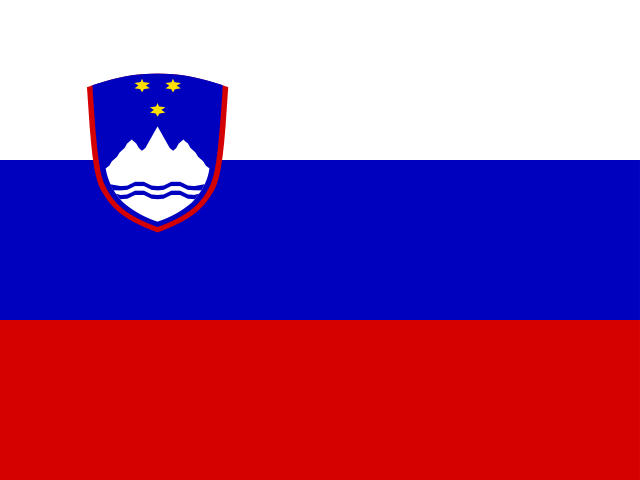
Flag of Slovenia
Three equal horizontal bands of white, blue, and red, derive from the medieval coat of arms of the Duchy of Carniola.
Spot the white mountain and three stars on the shield. Slovakia’s shield has a white double cross instead.
Languages and local life
Where the name comes from The country's name means "Land of the Slavs" in Slovene.
Language profile Slovene (official) 87.7%, Croatian 2.8%, Serbo-Croatian 1.8%, Bosnian 1.6%, Serbian 1.6%, Hungarian 0.4% (official, only in municipalities where Hungarian nationals reside), Italian 0.2% (official, only in municipalities where Italian nationals reside), other or unspecified 3.9% (2002 est.).
Currency Euro (EUR).
Borders and landscape
Area and borders Total area is about 20,273 km². It shares land borders with Austria, Croatia, Italy and Hungary.
Landscape A short southwestern coastal strip of Karst topography on the Adriatic; an alpine mountain region lies adjacent to Italy and Austria in the north; mixed mountains and valleys with numerous rivers to the east.
From high to low Highest point: Triglav 2,864 m. Lowest point: Adriatic Sea 0 m.
A person connected to this country
What they contributed “for his invention of the method of micro-analysis of organic substances”
The person Fritz Pregl, born in Ljubljana, received the 1923 Nobel Prize in Chemistry.
Where they worked Graz University at the time of the award.
Where it is
On the map Slovenia reaches the Adriatic west of its interior valleys, while Alpine terrain rises at its northwestern edge.
Where people live A fairly even distribution throughout most of the country, with urban areas attracting larger and denser populations; pockets in the mountainous northwest exhibit less density than elsewhere.