
Switzerland
Switzerland occupies part of the central Alps and shares Lake Geneva with France.
- Capital
- Bern
- Region
- Western Europe
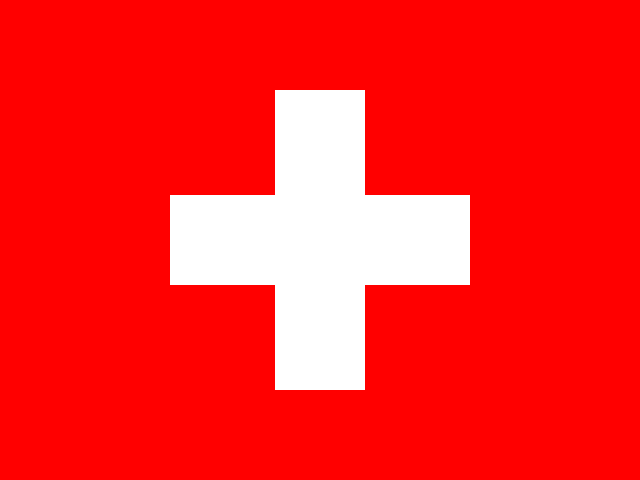
Flag of Switzerland
The white cross was used as a common emblem by soldiers of the Swiss Confederacy.
Switzerland’s white cross stops short of all four edges. Denmark’s reaches the edges and sits left of centre.
Languages and local life
Where the name comes from Name derives from the canton of Schwyz, one of the founding cantons of the Swiss Confederacy that formed in the late 13th century.
Language profile German (or Swiss German) (official) 62.1%, French (official) 22.8%, Italian (official) 8%, English 5.7%, Portuguese 3.5%, Albanian 3.3%, Serbo-Croatian 2.3%, Spanish 2.3%, Romansh (official) 0.5%, other 7.9% (2019 est.).
Currency Swiss franc (CHF).
Borders and landscape
Area and borders Total area is about 41,284 km². It shares land borders with Austria, France, Italy, Liechtenstein and Germany.
Landscape Mostly mountains (Alps in south, Jura in northwest) with a central plateau of rolling hills, plains, and large lakes.
From high to low Highest point: Dufourspitze 4,634 m. Lowest point: Lake Maggiore 195 m.
A person connected to this country
What they contributed “for the discovery of an exoplanet orbiting a solar-type star”
The person Didier Queloz, born in Geneva, received the 2019 Nobel Prize in Physics.
Where they worked University of Geneva and University of Cambridge at the time of the award.
Where it is
On the map Switzerland occupies part of the central Alps and shares Lake Geneva with France.
Where people live Population distribution corresponds to elevation with the northern and western areas far more heavily populated; the higher Alps of the south limit settlement.