
Denmark
Denmark combines Jutland with nearby islands that sit between the North Sea and the Baltic.
- Capital
- Copenhagen
- Region
- Northern Europe
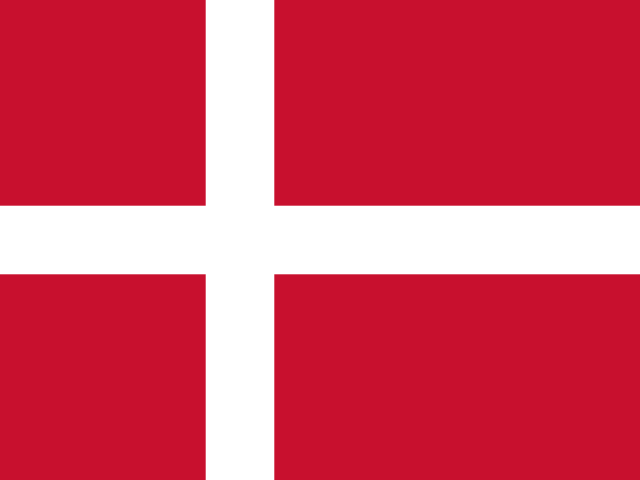
Flag of Denmark
The off-centre white cross is the Nordic cross. Denmark’s Dannebrog is among the oldest national flags still in use.
Think white on red, all the way to the edges. A white cross that stays inside the red is Switzerland.
Compare with Norway · Iceland · Finland · Sweden · Switzerland · Georgia · Tonga.
Languages and local life
Where the name comes from The name derives from the words "Dane(s)" and "mark"; the latter referring to a march (borderland) or forest.
Language profile Danish, Faroese, Greenlandic (an Inuit dialect), German (small minority); note - English is the predominant second language.
Currency Danish krone (DKK).
Borders and landscape
Area and borders Total area is about 43,094 km². It shares land borders with Germany.
Landscape Low and flat to gently rolling plains.
From high to low Highest point: Store Mollehoj 171 m. Lowest point: Lammefjord -7 m.
A person connected to this country
What they contributed “for the development of click chemistry and bioorthogonal chemistry”
The person Morten Meldal, born in Copenhagen, received the 2022 Nobel Prize in Chemistry.
Where they worked University of Copenhagen at the time of the award.
Where it is
On the map Denmark combines Jutland with nearby islands that sit between the North Sea and the Baltic.
Where people live With excellent access to the North Sea, Skagerrak, Kattegat, and the Baltic Sea, population centers tend to be along coastal areas, particularly in Copenhagen and the eastern side of the country's mainland.