
Vanuatu
Vanuatu is the volcanic island chain in that part of Melanesia, with its capital on Efate.
- Capital
- Port Vila
- Region
- Melanesia
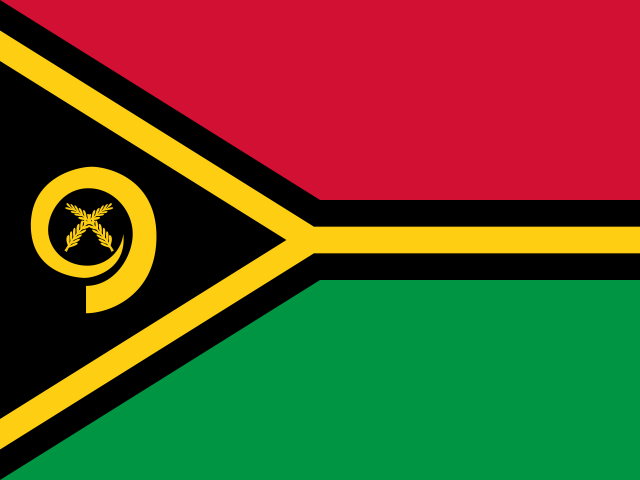
Flag of Vanuatu
Red represents the blood of boars and men, as well as unity, green the richness of the islands, and black the ni-Vanuatu people.
Follow the yellow Y. The fork opens towards the left, where the black triangle holds a curled tusk.
Compare with Guyana · South Africa · Seychelles.
Languages and local life
Where the name comes from Derived from the words "vanua" (home or land) and "tu" (stand) that occur in several of the Austonesian languages spoken on the islands and which provide a meaning of "the land remains" but which also convey a sense of "independence" or "our land".
Language profile Indigenous languages (more than 100) 82.6%, Bislama (official; creole) 14.5%, English (official) 2.1%, French (official) 0.8% (2020 est.).
Currency Vanuatu vatu (VUV).
Borders and landscape
Area and borders Total area is about 12,189 km².
Landscape Mostly mountainous islands of volcanic origin; narrow coastal plains.
From high to low Highest point: Tabwemasana 1,877 m. Lowest point: Pacific Ocean 0 m.
Where it is
On the map Vanuatu is the volcanic island chain in that part of Melanesia, with its capital on Efate.
Where people live Three-quarters of the population lives in rural areas; the urban populace lives primarily in two cities, Port-Vila and Lugenville; three largest islands - Espiritu Santo, Malakula, and Efate - accomodate over half of the populace.
A person connected to this country
Profile Walter Hadye Lin̄i ( he-di li-ni Bislama pronunciation: [haedi liŋi]; 1941 – 21 February 1999) was a Raga Anglican priest and politician who was the first Prime Minister of Vanuatu, from independence in 1980 to 1991. He was born at Agatoa village, Pentecost Island.
From the biography “Lin̄i was a key figure in Vanuatu's struggle for independence.”